Tuesday, September 17, 2013

Novena to St. Padre Pio – Begin Sept.14 through Sept. 23 - Day 4


DAY 4

Preface: Oh most Holy God, we humbly prostrate ourselves before Thy Infinite Majesty, and we adore Thee and dedicate to Thy glory the devout prayers which we now present to Thee, as an act of devotion to your servant, St Padre Pio, whose intercession we are now imploring.

Oh blessed Saint Padre Pio, you were a priest after the Heart of Jesus, seeking always to love and please Him in all things. We ask you to place this request before the Sacred Heart of Jesus (mention request). And through the love that you bore the most Sacred Heart of Jesus, may God hear and answer our poor prayers.

    
Recite one Our Father, one Hail Mary and one Glory Be...

May God hear and answer our prayer according to His holy Will and for His greater glory. We ask this through Jesus Christ our Lord, AMEN. †

-St Padre Pio, pray for us!


 Dear God, Thou hast generously blessed Thy servant, St. Pio of Pietrelcina, with the gifts of the Spirit. Thou hast marked his body with the five wounds of Christ Crucified, as a powerful witness to the saving Passion and Death of Thy Son. Endowed with the gift of discernment, St. Pio labored endlessly in the confessional for the salvation of souls. With reverence and intense devotion in the celebration of Mass, he invited countless men and women to a greater union with Jesus Christ in the Sacrament of the Holy Eucharist. Through the intercession of St. Pio of Pietrelcina, I confidently beseech Thee to grant me the grace of (mention your intentions here). Amen.
Recite three Glorias.

Monday, September 16, 2013

Novena to St. Padre Pio – Begin Sept.14 through Sept. 23

 DAY 3


Preface: Oh most Holy God, we humbly prostrate ourselves before Thy Infinite Majesty, and we adore Thee and dedicate to Thy glory the devout prayers which we now present to Thee, as an act of devotion to your servant, St Padre Pio, whose intercession we are now imploring.

Oh most loving Saint Padre Pio, you offered your life to become a holy priest of God, giving yourself completely to Jesus through the intercession of His Mother, the most Blessed Virgin Mary. We ask you to join with our holy Mother in heaven, and to present this request to Her holy Son, (here mention request), and we ask our beloved Mother in heaven to join you and obtain this grace for us.


Recite one Our Father, one Hail Mary and one Glory Be...

May God hear and answer our prayer according to His holy will and for His greater glory. We ask this through Jesus Christ our Lord, AMEN. †
-St Padre Pio, pray for us!
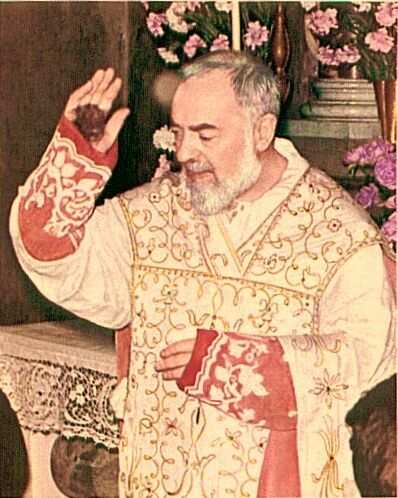

 Dear God, Thou hast generously blessed Thy servant, St. Pio of Pietrelcina, with the gifts of the Spirit. Thou hast marked his body with the five wounds of Christ Crucified, as a powerful witness to the saving Passion and Death of Thy Son. Endowed with the gift of discernment, St. Pio labored endlessly in the confessional for the salvation of souls. With reverence and intense devotion in the celebration of Mass, he invited countless men and women to a greater union with Jesus Christ in the Sacrament of the Holy Eucharist. Through the intercession of St. Pio of Pietrelcina, I confidently beseech Thee to grant me the grace of (mention your intentions here). Amen.
Recite three Glorias.

Sunday, September 15, 2013

Novena to St. Padre Pio – Begin Sept.14 through Sept. 23

DAY 2


Preface: Oh most Holy God, we humbly prostrate ourselves before Thy Infinite Majesty, and we adore Thee and dedicate to Thy glory the devout prayers which we now present to Thee, as an act of devotion to your servant, St Padre Pio, whose intercession we are now imploring.

Oh beloved Saint of God, Padre Pio, you were especially chosen by God to bear the holy stigmata in union with Jesus for 50 years, sacrificing and suffering all for the conversion of souls. What intense suffering these holy wounds caused you! But your bore this constant pain for the love of God and for the love of souls. We ask you to place this request (mention request) into your stigmatised hands, and present it to Jesus in our name.

-Recite one Our Father, one Hail Mary and one Glory Be...

May God hear and answer our prayer according to His holy will and for His greater glory. We ask this through Jesus Christ our Lord, AMEN. +

-St Padre Pio, pray for us!

 Dear God, Thou hast generously blessed Thy servant, St. Pio of Pietrelcina, with the gifts of the Spirit. Thou hast marked his body with the five wounds of Christ Crucified, as a powerful witness to the saving Passion and Death of Thy Son. Endowed with the gift of discernment, St. Pio labored endlessly in the confessional for the salvation of souls. With reverence and intense devotion in the celebration of Mass, he invited countless men and women to a greater union with Jesus Christ in the Sacrament of the Holy Eucharist. Through the intercession of St. Pio of Pietrelcina, I confidently beseech Thee to grant me the grace of (mention your intentions here). Amen.
Recite three Glorias.

Saturday, September 14, 2013

Novena to St. Padre Pio – Begin Sept.14 through Sept. 23

St Padre Pio Novena -A Novena to Saint Padré Pio seeking his intercession for a special grace.

Day 1
Preface: Oh most Holy God, we humbly prostrate ourselves before Thy Infinite Majesty, and we adore Thee and dedicate to Thy glory the devout prayers which we now present to Thee, as an act of devotion to your servant, St Padre Pio, whose intercession we are now imploring.

Oh holy Saint Padre Pio, throughout your entire life you sought always to love Jesus and Mary with your whole heart. Help us that we too may always seek to know, love and serve God with all of our hearts, and help us to seek His holy will in all things. And for the love of God we ask the following grace (mention your request). Beloved St Padre Pio, we give this request to you, seeking your heavenly intercession, and we ask you to make this request in our name before the throne of God.

Recite one Our Father, one Hail Mary and one Glory Be...

May God hear and answer our prayer according to His holy Will and for His greater glory. We ask this through Jesus Christ our Lord, AMEN. † -St Padre Pio, pray for us!


 Dear God, Thou hast generously blessed Thy servant, St. Pio of Pietrelcina, with the gifts of the Spirit. Thou hast marked his body with the five wounds of Christ Crucified, as a powerful witness to the saving Passion and Death of Thy Son. Endowed with the gift of discernment, St. Pio labored endlessly in the confessional for the salvation of souls. With reverence and intense devotion in the celebration of Mass, he invited countless men and women to a greater union with Jesus Christ in the Sacrament of the Holy Eucharist. Through the intercession of St. Pio of Pietrelcina, I confidently beseech Thee to grant me the grace of (mention your intentions here). Amen.

Recite three Glorias.

Monday, September 9, 2013

St. Peter Claver Feast Day

Today is the feast of St Peter Claver, a 17th century Jesuit stationed in Cartagena in the Spanish Colonies. During his time spent preparing for ordination as a Scholastic, Claver was disturbed by the slave trade and the treatment and living conditions of African slaves. Claver worked under Fr Alfonso Sandoval in ministering to the slaves, and when Claver professed his vows and succeeded Sandoval, he signed his profession, "Peter Claver, servant of the Africans forever."

Claver took to greet incoming ships bearing slaves, boarding the vessels and attending to those who had survived the horrific journey, giving them food and medicine. He often experienced conflicts with his fellow Jesuits, who did not share his feelings about slavery. Though still enslaved and oppressed, the lives of many slaves were improved by the work of Peter Claver. Because of his advocacy he was considered a nuisance by city officials.

He was canonized in 1888 and is considered the patron saint of the enslaved and of ministry to African Americans. He is also the patron of the Knights of Peter Claver, the largest African American Catholic fraternal organization in the U.S.

May we all be inspired by St. Peter Claver to be disturbed and disgusted by institutional racism and oppression, and may those of us in positions of power and privilege uphold the human dignity of the oppressed. #catholic
Today is the feast of St Peter Claver, a 17th century Jesuit stationed in Cartagena in the Spanish Colonies. During his time spent preparing for ordination as a Scholastic, Claver was disturbed by the slave trade and the treatment and living conditions of African slaves. Claver worked under Fr Alfonso Sandoval in ministering to the slaves, and when Claver professed his vows and succeeded Sandoval, he signed his profession, "Peter Claver, servant of the Africans forever."

Claver took to greet incoming ships bearing slaves, boarding the vessels and attending to those who had survived the horrific journey, giving them food and medicine. He often experienced conflicts with his fellow Jesuits, who did not share his feelings about slavery. Though still enslaved and oppressed, the lives of many slaves were improved by the work of Peter Claver. Because of his advocacy he was considered a nuisance by city officials.

He was canonized in 1888 and is considered the patron saint of the enslaved and of ministry to African Americans. He is also the patron of the Knights of Peter Claver, the largest African American Catholic fraternal organization in the U.S.

May we all be inspired by St. Peter Claver to be disturbed and disgusted by institutional racism and oppression, and may those of us in positions of power and privilege uphold the human dignity of the oppressed.

Monday, September 2, 2013

September 7th Prayer Vigil for Peace in the Middle East & the World

"I have decided to proclaim for the whole Church on 7 Sept. next, the vigil of the birth of Mary, Queen of Peace, a day of fasting and prayer for peace in Syria, the Middle East, and throughout the world"

Here is a Vatican translation of the Pope's address yesterday morning, given before and after praying the midday Angelus with the faithful gathered in St. Peter's Square. 

Dear Brothers and Sisters, Hello!

Today, dear brothers and sisters, I wish to add my voice to the cry which rises up with increasing anguish from every part of the world, from every people, from the heart of each person, from the one great family which is humanity: it is the cry for peace! It is a cry which declares with force: we want a peaceful world, we want to be men and women of peace, and we want in our society, torn apart by divisions and conflict, that peace break out! War never again! Never again war! Peace is a precious gift, which must be promoted and protected.

There are so many conflicts in this world which cause me great suffering and worry, but in these days my heart is deeply wounded in particular by what is happening in Syria and anguished by the dramatic developments which are looming.

I appeal strongly for peace, an appeal which arises from deep within me. How much suffering, how much devastation, how much pain has the use of arms carried in its wake in that martyred country, especially among civilians and the unarmed! I think of many children who will not see the light of the future! With utmost firmness I condemn the use of chemical weapons: I tell you that those terrible images from recent days are burned into my mind and heart. There is a judgment of God and of history upon our actions which are inescapable! Never has the use of violence brought peace in its wake. War begets war, violence begets violence.

With all my strength, I ask each party in this conflict to listen to the voice of their own conscience, not to close themselves in solely on their own interests, but rather to look at each other as brothers and decisively and courageously to follow the path of encounter and negotiation, and so overcome blind conflict. With similar vigour I exhort the international community to make every effort to promote clear proposals for peace in that country without further delay, a peace based on dialogue and negotiation, for the good of the entire Syrian people.
May no effort be spared in guaranteeing humanitarian assistance to those wounded by this terrible conflict, in particular those forced to flee and the many refugees in nearby countries. May humanitarian workers, charged with the task of alleviating the sufferings of these people, be granted access so as to provide the necessary aid.

What can we do to make peace in the world? As Pope John said, it pertains to each individual to establish new relationships in human society under the mastery and guidance of justice and love (cf. John XXIII, Pacem in Terris, [11 April 1963]: AAS 55, [1963], 301-302).

All men and women of good will are bound by the task of pursuing peace. I make a forceful and urgent call to the entire Catholic Church, and also to every Christian of other confessions, as well as to followers of every religion and to those brothers and sisters who do not believe: peace is a good which overcomes every barrier, because it belongs all of humanity!

I repeat forcefully: it is neither a culture of confrontation nor a culture of conflict which builds harmony within and between peoples, but rather a culture of encounter and a culture of dialogue; this is the only way to peace.

May the plea for peace rise up and touch the heart of everyone so that they may lay down their weapons and let themselves be led by the desire for peace.
To this end, brothers and sisters, I have decided to proclaim for the whole Church on 7 September next, the vigil of the birth of Mary, Queen of Peace, a day of fasting and prayer for peace in Syria, the Middle East, and throughout the world, and I also invite each person, including our fellow Christians, followers of other religions and all men of good will, to participate, in whatever way they can, in this initiative.

On 7 September, in Saint Peter’s Square, here, from 19:00 until 24:00, we will gather in prayer and in a spirit of penance, invoking God’s great gift of peace upon the beloved nation of Syria and upon each situation of conflict and violence around the world. Humanity needs to see these gestures of peace and to hear words of hope and peace! I ask all the local churches, in addition to fasting, that they gather to pray for this intention.

Let us ask Mary to help us to respond to violence, to conflict and to war, with the power of dialogue, reconciliation and love. She is our mother: may she help us to find peace; all of us are her children! Help us, Mary, to overcome this most difficult moment and to dedicate ourselves each day to building in every situation an authentic culture of encounter and peace. Mary, Queen of Peace, pray for us!

Monday, August 26, 2013

Archbishop Chaput: The Church Is "A Heretic Of The World's New Order"

 Earlier in the week, Archbishop Charles Chaput gave a speech at the 15th Symposium of the Canon Law Association of Slovakia, entitled "Living Within The Truth: Religious Liberty and Catholic Mission in the New Order of the World". It is riveting and inspiring, and ought to be read by everyone.
Here is but a mere excerpt:
Writing in the 1960s, Richard Weaver, an American scholar and social philosopher, said: “I am absolutely convinced that relativism must eventually lead to a regime of force.”

He was right. There is a kind of “inner logic” that leads relativism to repression.

This explains the paradox of how Western societies can preach tolerance and diversity while aggressively undermining and penalizing Catholic life. The dogma of tolerance cannot tolerate the Church’s belief that some ideas and behaviors should not be tolerated because they dehumanize us. The dogma that all truths are relative cannot allow the thought that some truths might not be.


The Catholic beliefs that most deeply irritate the orthodoxies of the West are those concerning abortion, sexuality and the marriage of man and woman. This is no accident. These Christian beliefs express the truth about human fertility, meaning and destiny.
These truths are subversive in a world that would have us believe that God is not necessary and that human life has no inherent nature or purpose. Thus the Church must be punished because, despite all the sins and weaknesses of her people, she is still the bride of Jesus Christ; still a source of beauty, meaning and hope that refuses to die -- and still the most compelling and dangerous heretic of the world’s new order.
Let me sum up what I’ve been saying.


My first point is this: Ideas have consequences. And bad ideas have bad consequences. Today we are living in a world that is under the sway of some very destructive ideas, the worst being that men and women can live as if God does not matter and as if the Son of God never walked this earth. As a result of these bad ideas, the Church’s freedom to exercise her mission is under attack. We need to understand why that is, and we need to do something about it.

My second point is simply this: We can no longer afford to treat the debate over secularization -- which really means cauterizing Christianity out of our cultural memory -- as if it’s a problem for Church professionals. The emergence of a “new Europe” and a “next America” rooted in something other than the real facts of our Christian-shaped history will have damaging consequences for every serious believer.
We need not and should not abandon the hard work of honest dialogue. Far from it. The Church always needs to seek friendships, areas of agreement, and ways to make positive, reasoned arguments in the public square. But it’s foolish to expect gratitude or even respect from our governing and cultural leadership classes today. NaĂ¯ve imprudence is not an evangelical virtue.


The temptation in every age of the Church is to try to get along with Caesar. And it’s very true: Scripture tells us to respect and pray for our leaders. We need to have a healthy love for the countries we call home. But we can never render unto Caesar what belongs to God. We need to obey God first; the obligations of political authority always come second. We cannot collaborate with evil without gradually becoming evil ourselves. This is one of the most vividly harsh lessons of the 20th century. And it’s a lesson that I hope we have learned. 


That brings me to my third and final point today: We live in a time when the Church is called to be a believing community of resistance. We need to call things by their true names. We need to fight the evils we see. And most importantly, we must not delude ourselves into thinking that by going along with the voices of secularism and de-Christianization we can somehow mitigate or change things. Only the Truth can set men free. We need to be apostles of Jesus Christ and the Truth he incarnates.


May God bless Archbishop Charles Chaput.

Saturday, August 24, 2013

Future Bishops and Popes: How Much Authority?

crozierPope Francis is contemplating a major reworking of the top-level administrative machinery of the Church. Commentators sometimes describe this as “reforming the Roman Curia,” but if the Pope’s own words–together with public and private proposals intended to influence the result–are any indication, the project could extend far beyond  reshuffling dicasteries and straightening out the affairs of the Institute for the Works of Religion (the Vatican bank).
In all cases, “collegiality” is said to be both the working principle and the objective of  reform. The word refers to the doctrine, revived by Vatican Council II, that the bishops share in teaching and governing the universal Church in union with the pope. The question that obviously raises is how it’s to be done.
One answer, a conservative one, is that diocesan bishops make their most important contribution to collegial governance by teaching and governing their own dioceses well. But although collegiality in that sense is essential, it is no less clear that the collegial principle extends to some form of collective participation in teaching and governing the entire Church. Ecumenical councils are conspicuous examples.
The world Synod of Bishops, a Vatican II innovation, was intended as yet another instrument of collegiality. But although the synod has occupied an honorable place in ecclesial life for 40-plus years, its role so far has been confined to advising the pope on questions he selects rather than sharing in the actual making of decisions.

So where does collegiality go from here? 
Enter Pope Francis’ project and the maneuvering now underway.

In general terms, there currently are two different approaches on the table. One points to a large scale decentralization of authority, the other, as might be expected, toward dramatic centralization. Advocates of each cite the principle of collegiality as their rationale.
Under the decentralization model, diocesan bishops and, especially, national conferences of bishops would have much greater authority for decision-making than they do now.
Liberals tend to favor that. This is partly out of concern for collegiality and partly because they see it as a way to realize such long-sought goals of theirs as married priests, communion for the divorced and remarried, a more permissive approach to questions of sexual morality, and in the long run perhaps even the ordination of women.
By contrast, some conservatives favor more centralization–and, paradoxically, for the sake of the collegiality principle.

One such plan would call for the creation of a permanent, synod-like representative body in Rome, its members nominated by the world’s bishops and selected by the Pope. Acting in union with the pontiff, and never apart from him, it would have the power to make doctrinal and disciplinary decisions for the worldwide  Church. Its advantage is said to lie in being an authentic embodiment of collegiality that involves no diminution of papal primacy while responding to the need of the universal Church for speedy decision-making and unimpaired cohesiveness in an era of instantaneous communication and globalization.
From October 1 to 3 Pope Francis will meet for the first time with the special council of eight cardinals that he has established to advise him on these matters. (Cardinal Sean O’Malley, O.F.M. Cap., of Boston is one of the eight.) While this will be the group’s first face-to-face meeting, the Pope and the eight are presumed to have been in frequent contact and have already spent much time mulling ideas like those sketched here.

Catholics everywhere should be paying close attention
The results could be of huge importance for the future of the Church.

 by Russell Shaw


We know that Jesus promised that the gates of hell would never prevail against the Church. We trust in this. We know the camp is already divided on those that say this is a good pope and this is the bad pope. We know that IF he's the bad pope that all his evil will initially be masked well to deceive 'even the elect'. There is no way now to determine what these proposed new changes will bring; but we must remember that nothing can happen without Jesus permitting it and if He permits it, He's got it covered!! We also know that in the end times, the Church will follow her Master. I believe the Passion has already begun and perhaps the Crucifixion is not far off ... but all that means is that the RESURRECTION IS THAT MUCH CLOSER!! So, whether you like this pope or not, whether the changes that come in the Church will be good or bad; know with certainty that God truly IS in control and certain things must pass for prophecy to be fulfilled. Jesus did not shirk from any suffering, He accepted and bore all for love of us, can we do any less for Him? SO! ~~ If these changes are bad for the Church, blessed be God ... if these changes are good for the Church, blessed be God!! PRAY, TRUST & try not to WORRY!! ~Mary

Friday, July 26, 2013

SAINT ANNE; Mother of the Blessed Virgin ~ Feast: July 26

Of St. Anne we have no certain knowledge. She is not mentioned in the New Testament, and we must depend on apocryphal literature, chiefly the Protoevangelium of James, which dates back only to the second century.

We are told that Anne, wife of  Joachim, was advanced in years and that her prayers for a child had not been answered. Once as she prayed beneath a laurel tree near her home in Galilee, an angel appeared and said to her, "Anne, the Lord hath heard thy prayer and thou shalt conceive and bring forth, and thy seed shall be spoken of in all the world." Anne replied, "As the Lord my God liveth, if I beget either male or female, I will bring it as a gift to the Lord my God; and it shall minister to Him in holy things all the days of its life " And thus Anne became the mother of the Blessed Virgin Mary.

The devotion of St. Anne was known in the East in the fifth century, but it was not diffused in the West until the thirteenth. A shrine at Douai, in northern France, was one of the early centers of the devotion. In 1382 her feast was extended to the whole Western Church, and she became very popular, especially in France. Her two most famous shrines are at St. Anne d'Auray in Brittany and at St. Anne-de Beaupre in the province of Quebec.
She is patroness of housewives, women in labor, cabinet-makers, and miners. Her emblem is a door. St. Anne has been frequently represented in art, and the lovely face depicted by Leonardo da Vinci comes first to mind in this connection. The name Anne derives from the Hebrew Hannah, meaning "grace."

St Anne Prayer (To Obtain Some Special Favor)
Glorious St. Ann, filled with compassion for those who invoke you and with love for those who suffer, heavily laden with the weight of my troubles, I cast myself at your feet and humbly beg of you to take the present affair which I recommend to you under your special protection.

St. Ann, please, recommend to your daughter, the Blessed Virgin Mary, and lay it before the throne of Jesus, so that He may bring it to a happy issue.
St. Ann cease not to intercede for me until my request is granted. (Here ask for favor you wish to obtain.)

Above all, obtain for me the grace of one day beholding my God face to face, and with You and Mary and all the saints, praising and blessing Him through all eternity. Amen.
Good St. Ann, mother of her who is our life, our sweetness and our hope, pray to her for us and obtain our request. (Three times).

The Miraculous Discovery of St. Ann’s Relics
 
According to a most ancient and uninterrupted tradition, the body of St. Ann was carried to Gaul [a province of the Roman empire which included what are now the countries of France and upper Italy] by the same vessel which carried Lazarus and his sisters there. During the first century of the Christian era, these friends of Our Lord were banished from Palestine because of their faith. From their hands St. Ann’s precious remains were taken for safekeeping to the city of Apta Julia, which in our own times is the city of Apt, France.

In those stormy days of persecution, it was necessary to hide the relics of the Martyrs and Saints.  Consequently, the body of St. Ann was buried in an underground church or crypt. The martyrology of Apt, one of the most ancient in existence, mentions this fact.

The first bishop of Apta Julia, St. Auspicius, who died before 118, took further precautions to guard this holy treasure from desecration and had the body buried still deeper in the subterranean chapel. All approach to it was carefully concealed till persecutions and invasions should have ceased. For centuries, the country was repeatedly overrun by hordes of barbarians, and it was only natural that during these agitated years the precise spot where St. Auspicius had carefully hidden his treasure became lost in obscurity.

After Charlemagne’s decisive victory over the Saracens at the close of the eighth century, peace and security returned to Gaul. It was then that the people began to restore and rebuild the holy places destroyed or desecrated by the invaders. Priests and bishops of Apta Julia began to seek for the exact spot in the deep crypt where St. Auspicius had hidden and walled up the sarcophagus of St. Ann.

Charlemagne’s first care on his arrival at Apt was to have the cathedral re-consecrated. This took place during the Easter solemnities, in the presence of an enormous crowd of nobles, clergy and people. But there was one cause of sadness amid all the rejoicing, namely, that every effort to find the remains of St. Ann had proved fruitless. A miracle, however, was to lead to the discovery of her resting place, as is related by Charlemagne in a letter to Pope Adrian I.

Among the young nobles who accompanied their parents on this occasion was John, a lad of fourteen, the son of Baron Casanova, deaf, dumb and blind from birth. People near the boy in the sanctuary remarked that during the services he was carried away by some overpowering emotion.

With rapt and upturned face he seemed to be listening to voices from above. Presently, he moved toward the high altar, struck with his staff the steps leading up to it and made signs that they should dig there. His persistence caused considerable disturbance amid the solemn rites, but neither the clergy nor the royal guards could quiet or restrain the youth.

Charlemagne was deeply impressed. After Mass, he commanded that the excavation desired by the boy should be made. The altar steps were removed and a door, closed up with huge stones, was revealed. This was the door of the ancient crypt in which St. Auspicius had been accustomed to celebrate the holy Mysteries and to feed his flock with the Bread of Life. Its size and adornments reminded one of the Roman catacombs.

No sooner had this door been opened and the flight of steps leading down from it disclosed than the blind boy rushed forward, as if his eyes had been suddenly opened, and led the way into this underground church. Charlemagne now held the boy’s hand and gave orders to keep back the excited multitude. John made signs that they should search farther, and he struck the wall of the crypt, indicating that what they sought lay beyond. When the wall was broken down, another and lower crypt was discovered at the end of a long and narrow corridor.

As they came in view of this crypt, a bright light flashed upon the Emperor and his assistants. They beheld, in front of a walled recess, a burning lamp, which flooded the place with unearthly splendor. No sooner, however, had the Emperor and his cortege entered this place, than the lamp went out. But, more wonderful still, at that very moment the blind boy could see, speak and hear.

“The body of Saint Ann,mother of the Virgin Mary, Mother of God, is in yonder recess,” were his first words. The awe-stricken Emperor and his followers, at first dumb with amazement, gave vent to their emotion in words of praise and thanksgiving. The walled recess was thrown open, a sweet fragrance like that of oriental balm filled the air, and a casket of cypress wood was discovered containing the body of St. Ann wrapped round and round with folds of precious cloth. On the casket was the inscription: “Here lies the body of Blessed Ann, mother of the Virgin Mary.”

Charlemagne, with all those present, venerated the sacred deposit thus brought to light. Afterward he had an exact narrative of the discovery drawn up by one of his notaries and a copy sent to the Pope with the royal letter. This letter and the Pope’s answer are still extant.

The miraculous discovery at once made the Cathedral of Apt the center of attraction for Christian pilgrims from every part of Gaul. In the wars which followed the reign of Charlemagne down to our own times, the clergy and people of Apt have watched with never failing love over the sacred treasure which is the glory of their city.
Travelers visiting the venerable Cathedral of St. Auspicius will find piles of ex votos, the indisputable testimonies during eleven centuries of the wonders wrought there by Christ at
the intercession of His sainted Grandmother. The chief cities of Gaul hastened to solicit from the church of Apta Julia portions of the hallowed body thus miraculously discovered. Fragments detached from the head found their way to various places through the favor of sovereigns or powerful prelates, but the greatest portion of St. Ann’s sacred body still reposes in Apt. Vienna, Austria, possesses the right hand of St. Ann, which is devoutly venerated in the beautiful church which bears her name.
An arm of the Saint was solicited and obtained by the Popes and placed under the care of the Benedictine monks in the magnificent monastery church of St. Paul-Outside-the-Walls in Rome.

In May, 1960, the Benedictines gave the forearm to the Shrine of St. Anne de BeauprĂ© in Canada [pictured above]. In the Cathedral of Bologna, Italy, a large portion of the Saint’s head is venerated.

Through these precious relics, which have proved efficacious in every kind of distress, miracles have been wrought up to the present day.