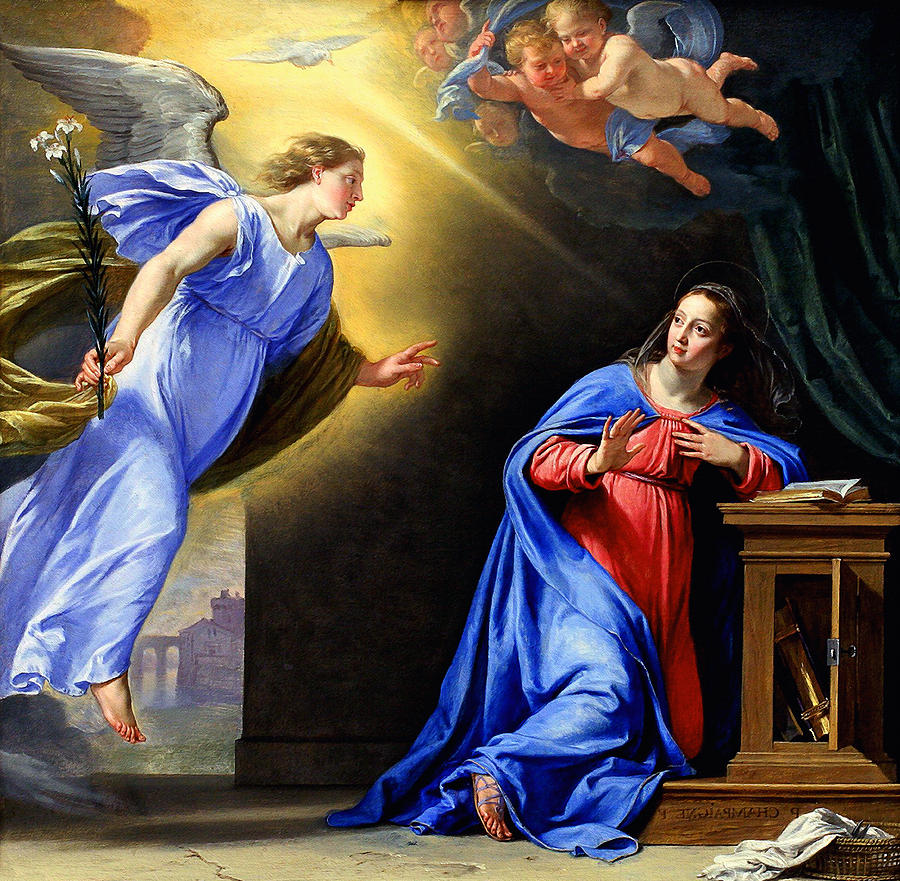
The fact of the Annunciation of the Blessed Virgin Mary is related in Luke 1:26-38. The Evangelist tells us that in the sixth month after the conception of St. John the Baptist by Elizabeth, the angel Gabriel was sent from God to the Virgin Mary, at Nazareth, a small town in the mountains of Galilee. Mary was of the house of David, and was espoused (i.e. married) to Joseph, of the same royal family. She had, however, not yet entered the household of her spouse, but was still in her mother's house, working, perhaps, over her dowry. (Bardenhewer, Maria Verk., 69). And the angel having taken the figure and the form of man, came into the house and said to her: "Hail, full of grace (to whom is given grace, favored one), the Lord is with thee." Mary having heard the greeting words did not speak; she was troubled in spirit, since she knew not the angel, nor the cause of his coming, nor the meaning of the salutation.
And the angel continued and said: "Fear not, Mary, for thou hast found grace with God. Behold thou shalt conceive in thy womb, and shalt bring forth a son; and thou shalt call his name Jesus. He shall be great, and shall be called the Son of the Most High; and the Lord God shall give unto him the throne of David his father; and he shall reign in the house of Jacob forever. And of his kingdom there shall be no end." The Virgin understood that there was question of the coming Redeemer. But, why should she be elected from amongst women for the splendid dignity of being the mother of the Messiah, having vowed her virginity to God? (St. Augustine). Therefore, not doubting the word of God like Zachary, but filled with fear and astonishment, she said: "How shall this be done, because I know not man?"
The angel, to remove Mary's anxiety and to assure her that her virginity would be spared, answered: "The Holy Ghost shall descend upon thee and the power of the Most High shall overshadow thee. And therefore also the Holy which shall be born of thee shall be called the Son of God." In token of the truth of his word he made known to her the conception of St. John, the miraculous pregnancy of her relative now old and sterile: "And behold, thy cousin Elizabeth; she also has conceived a son in her old age, and this is the sixth month with her that is called barren: because no word shall be impossible with God." Mary may not yet have fully understood the meaning of the heavenly message and how the maternity might be reconciled with her vow of virginity, but clinging to the first words of the angel and trusting to the Omnipotence of God she said: "Behold the handmaid of the Lord, be it done to me according to thy word."
The Annunciation is the beginning of Jesus in His human nature. Through His mother He is a member of the human race. If the virginity of Mary before, during, and after the conception of her Divine Son was always considered part of the deposit of faith, this was done only on account of the historical facts and testimonials. The Incarnation of the Son of God did not in itself necessitate this exception from the laws of nature. Only reasons of expediency are given for it, chiefly, the end of the Incarnation. About to found a new generation of the children of God, The Redeemer does not arrive in the way of earthly generations: the power of the Holy Spirit enters the chaste womb of the Virgin, forming the humanity of Christ. Many holy fathers (Sts. Jerome, Cyril, Ephrem, Augustine) say that the consent of Mary was essential to the redemption.
It was the Will of God, St. Thomas says (Summa III:30), that the redemption of mankind should depend upon the consent of the Virgin Mary. This does not mean that God in His plans was bound by the will of a creature, and that man would not have been redeemed, if Mary had not consented. It only means that the consent of Mary was foreseen from all eternity, and therefore was received as essential into the design of God.
On March 19th we remember St. Joseph. I think St. Joseph is one of the most forgotten of all Saints, yet ... which of the other Saints were ever closer to our dear Lord? I have to stop and stand in awe of this faithful servant of God. Is he quoted in the Bible frequently? No. Does he have the fanfare and notoriety that many other Saints have? Not so much.
Let's stop a moment and really consider his role in redemption. One can hardly focus on St. Joseph without first looking at our Blessed Mother. Here we find a young girl not barely 'sweet sixteen' who is told something quite unbelievable to the average person, namely that she would conceive the Son of God in a miraculous way and remain a virgin. We all know this, but I think often many take it for granted that the times in which she lived were precarious at best. An unmarried woman that found herself pregnant would soon feel the biting sting of stones tearing and bruising her flesh and breaking her bones. Still, she trusted and accepted according to the Perfect Will of God without hesitation!
Then we have to look towards Joseph. An older man .. a widower who was to marry this young girl, yet what to do when he learns that she is with child? He knew full well what would be her fate if he publicly declared this. His kind and protective nature decided to just divorce her quietly and not cause her undue pain and scandal. We all know that God sent the angel to him in a dream to explain the situation and Joseph, trusting God as Mary did, believed and took her for his wife.
I would imagine they were both a little nervous about it all ... wondering how this could be .. what would happen next ... how would it all turn out?? I can only imagine the prayerful lives of faith that they led allowing them to trust to that extent and rely on God for the very next step all along the way. We all know the stories from our childhood, but have we ever stopped to really think what it all must have been like? Fleeing into Egypt .. fleeing from Herod ... losing Jesus as a young Boy and finding Him in the Temple amidst the elders, questioning and being questioned. St. Joseph taught the God-Man his carpentry trade. He and Mary played with Him, watched Him grow, comforted Him when He fell and taught Him how to pray!
So little is written of St. Joseph in Scripture ..
Neither Joseph or Mary together, have very many words recorded. But are there any more significant people in Scripture than the Mother and Foster-Father of the Christ Child? They don't say much, but they sure lead by example! St. Joseph was a faithful servant while on earth, chosen by the Holy Trinity to be a wonderful Foster-Father to Jesus and a faithful and protective virginal husband to Mary. As the head of the Holy Family, he is also the Patron of the Catholic Church. He is also the Patron Saint of families and workers as well. We need to call on him for his protection, employment, guidance and support in all things.
One of St. Joseph's most famous titles is Patron of a Happy Death. Why? How could death not be happy if one was to die in the arms of Jesus and Mary? We must never forget his suffering either. He truly is our Friend in Sufferings with all the fear, anxiety and panic he must have gone through in his diligent care of his beloved Family! Let us always turn to our foster father St. Joseph, asking him to present our petitions to our dear Lord and our Blessed Mother with the same tenderness and concern in which he protected them while on earth. Let our prayer be always to strive to embrace the perfect Divine Will of God in all things with a joyful and trusting heart as St. Joseph shows us by his shining example.
Jesus, Mary and Joseph .. please pray for us!
Memorare
Remember, most pure spouse of Mary, ever Virgin, my loving protector, Saint Joseph, that no one ever had recourse to your protection or asked for your aid without obtaining relief. Confiding, therefore, in your goodness, I come before you and humbly implore you. Despise not my petitions, foster-father of the Redeemer, but graciously receive them. Amen.
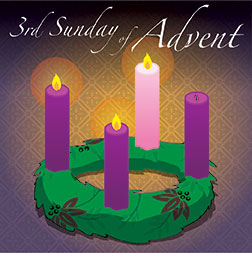
The third Sunday of Advent, so called from the first word of the Introit at Mass (Gaudete, i.e. Rejoice - pronounced Gaw-day-tay). The season of Advent originated as a fast of forty days in preparation for Christmas, commencing on the day after the feast of St. Martin (12 November), whence it was often called "St. Martin's Lent"-- a name by which it was known as early as the fifth century. The introduction of the Advent fast cannot be placed much earlier, because there is no evidence of Christmas being kept on 25 December before the end of the fourth century (Duchesne, "Origines du culte chrétien", Paris, 1889), and the preparation for the feast could not have been of earlier date than the feast itself. In the ninth century, the duration of Advent was reduced to four weeks, the first allusion to the shortened season being in a letter of St. Nicholas I (858-867) to the Bulgarians,and by the twelfth century the fast had been replaced by simple abstinence.
St. Gregory the Great was the first to draw up an Office for the Advent season, and the Gregorian Sacramentary is the earliest to provide Masses for the Sundays of Advent. In both Office and Mass provision is made for five Sundays, but by the tenth century four was the usual number, though some churches of France observed five as late as the thirteenth century. Notwithstanding all these modifications, however, Advent still preserved most of the characteristics of a penitential season which made it a kind of counterpart to Lent, the middle (or third) Sunday corresponding with Laetare or Mid-Lent Sunday.
On it, as on Laetare Sunday, the organ and flowers, forbidden during the rest of the season, were, permitted to be used; rose-colored vestments were allowed instead of purple (or black, as formerly); the deacon and subdeacon reassumed the dalmatic and tunicle at the chief Mass, and cardinals wore rose-color instead of purple. All these distinguishing marks have continued in use, and are the present discipline of the Latin Church. Gaudete Sunday, therefore, makes a breaker like Laetare Sunday, about midway through a season which is otherwise of a penitential character, and signifies the nearness of the Lord's coming. Of the "stations" kept in Rome the four Sundays of Advent, that at the Vatican basilica is assigned to Gaudete, as being the most important and imposing of the four. In both Office and Mass throughout Advent continual reference is made to our Lord's second coming, and this is emphasized on the third Sunday by the additional signs of gladness permitted on that day. Gaudete Sunday is further marked by a new Invitatory, the Church no longer inviting the faithful to adore merely "The Lord who is to come", but calling upon them to worship and hail with joy "The Lord who is now nigh and close at hand". The Nocturn lessons from the Prophecy of Isaias describe the Lord's coming and the blessings that will result from it, and the antiphons at Vespers re-echo the prophetic promises.
The joy of expectation is emphasized by the constant Alleluias, which occur in both Office and Mass throughout the entire season. In the Mass, the Introit "Gaudete in Domino semper" strikes the same note, and gives its name to the day. The Epistle again incites us to rejoicing, and bids us prepare to meet the coming Savior with prayers and supplication and thanksgiving, whilst the Gospel, the words of St. John Baptist, warns us that the Lamb of God is even now in our midst, though we appear to know Him not. The spirit of the Office and Liturgy all through Advent is one of expectation and preparation for the Christmas feast as well as for the second coming of Christ, and the penitential exercises suitable to that spirit are thus on Gaudete Sunday suspended, as were, for a while in order to symbolize that joy and gladness in the Promised Redemption which should never be absent from the heart of the faithful.
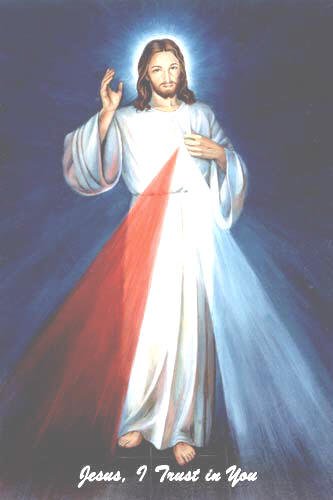
You expired, Jesus, but the source of life gushed forth for souls, and the ocean of mercy opened up for the whole world. O Fount of Life, unfathomable Divine Mercy, envelop the whole world and empty Yourself out upon us. O Blood and Water, which gushed forth from the Heart of Jesus as a fountain of Mercy for us, I trust in You!
On the first three beads: the Our Father, the Hail Mary and the Apostles' Creed.
On the Our Father [Pater] beads: Eternal Father, I offer you the Body and Blood, Soul and Divinity of Your Dearly Beloved Son, Our Lord, Jesus Christ, in atonement for our sins and those of the whole world.
On the Hail Mary [Ave] beads: For the sake of His sorrowful Passion, have mercy on us and on the whole world.
Closing Prayer
Eternal God, in whom mercy is endless and the treasury of compassion-inexhaustible, look kindly upon us and increase Your mercy in us, that in difficult moments we might not despair nor become despondent, but with great confidence submit ourselves to Your holy will, which is Love and Mercy itself.
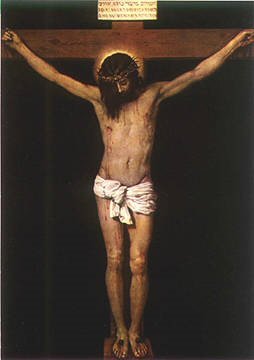
Chaplet of the Holy Wounds can use regular Rosary beads. Each decade is a meditation on one of the 5 Wounds of Our Lord, namely, His Hands, Feet and Side.
On the crucifix and first three beads:
O Jesus, Divine Redeemer, be merciful to us and to the whole world. Amen.
Strong God, holy God, immortal God, have mercy on us and on the whole world. Amen.
Grace and mercy O my Jesus, during present dangers; cover us with Thy Precious Blood. Amen.
Eternal Father, grant us mercy through the Blood of Jesus Christ, Thine only Son; grant us mercy, we beseech Thee. Amen.
(The following prayers, composed by Our Lord, are to be said using the Rosary beads.)
On the Our Father [Pater] beads: Eternal Father, I offer Thee. the Wounds of our Lord Jesus Christ. To heal the wounds of our souls. (300 days indulgence each time)
On the Hail Mary [Ave] beads: My Jesus, pardon and mercy. Through the merits of Thy Holy Wounds. (300 days indulgence each time)
Ending - Prayer for Purity - to Saint Joseph
O Guardian of Virgins and holy Father St. Joseph, into whose faithful keeping were entrusted Christ Jesus, Innocence itself, and Mary, Virgin of virgins, I pray and beseech Thee. by these dear pledges, Jesus and Mary, that, being preserved from all uncleanness, I may with spotless mind, pure heart and chaste body ever serve Jesus and Mary most chastely all the days of my life. Amen
Chaplet of the Immaculate Heart of Mary is said with an ordinary rosary.
The Sign of the Cross is made five times in veneration of the Savior's five Holy Wounds.
On the Our Father [Pater] beads:
Sorrowful and Immaculate Heart of Mary, Pray for those who seek refuge in you.
On the Hail Mary [Ave] beads:
Holy Mother, save us through your Immaculate Heart's flame of love.
At the end, the Glory Be to the Father is repeated three times.