I had written this some time ago ... not even sure when ... but just came across it again and it's TIMELY. If you don't care about this .... YOU SHOULD!
Oh for about a couple decades now at least, I've had a pet peeve .. spoken to only a handful of trusted friends .. something that really rubs me the wrong way and gets my dander up. There's a FIX for it .. but are we UP TO IT? To we have the GUTS to even SUGGEST IT? Time for fence sitting is LONG PAST. We need to begin getting our house in order and in my mind, the very first thing we need to do is:
PUT THE MASTER BACK WHERE HE BELONGS!!
Yep ... I'm talking about the Savior of the world, our Eucharistic Lord, JESUS! It was WRONG to move Him off to the side away from the main focus. Isn't that WHY we go to Church because we BELIEVE IN THE DIVINE PRESENCE OF THE EUCHARIST? Sit down and REALLY think about this. If you don't believe that Jesus is truly present in the Eucharist, you're not even CATHOLIC. He didn't say this is a representation of My Body and Blood ...
He said "THIS IS MY BODY, THIS IS MY BLOOD."
This has bothered me for SO long now ... Michael brought it to the fore front again and now I'm on a mission! We need .. WE ALL NEED to band together. Things are going to get tough enough here more quickly than we'd like. We need to be sure where we stand because those still sitting on the fence will soon find themselves sitting on what's left of their brains *ahem*. We need to follow Michael's advice and IN CHARITY do whatever it takes to get Jesus put BACK front and center as the MAIN FOCUS as it should be .. where He BELONGS!
Form groups, write letters, have talks and meetings ... if nothing is done and it's a closed issue, well then, I'd take my soul elsewhere to be nourished for the upcoming battle. It's too important NOT to have Him first in all things now and (right after the place in your heart), that begins with the altar in your parish.
If you can't get anywhere with your parish, contact the diocese or the arch diocese .. if you can't get anywhere with them .. well then you need to go where Jesus IS honored, respected and given the proper place due His DIVINITY! .... PERIOD!
Would You Like To Learn More About The Differences Between The Different Kinds And The Different Actions Of The Devil’s Minions? Then Read The Following!
We need to speak about reality of the evil spirits. I thought it might be appropriate to explain that with a little bit more detail so that we would understand exactly what it is we are working against.
Cardinal Spirits
There are spirits that are broken up into different kinds of categories. There are, for instance, the spirits that are called “cardinal spirits”. Cardinal spirits are the ones that we get in because of repeated sin. If we do the same thing over and over and over again, we open ourselves up to allow the devil in. We do not become possessed by these things, but rather we are oppressed by them. And what we need to do is work them back out by changing the habits that we have and changing our vices into virtues.
Ministering Spirits
There are what are called “ministering spirits”. Ministering spirits are huge things from the higher order of angels. They are the ones that live within the wounds that are inflicted upon us from the time that we are quite young, when there are traumatic things that happen in our lives when we are young (before 12 years old). These are the great, big things that get wrapped around our personality, and because of that, they are very, very difficult to even be able to recognize or to get rid of. The problem with ministering spirits is, first of all, they are exceedingly intelligent, which is why they go after little children rather than adults because their arrogance will not allow them to do anything else. They try to hide behind the personality of the people. These are the ones that will cause pride, selfishness, anger, and also fear. So when we see these kinds of problems in our lives, these are things that are rooted deep, deep within ourselves. They are in the wounds that were inflicted when we were young, and the only way to be able to get rid of them is to get inside and be able to address the woundedness, to heal those wounds that are there through forgiveness, through working through the various things in prayer. Slowly, we will be able to push these things away.
Occult Spirits
There are also occult spirits. These are the things that get in through occult practices. They can be sent or they can be summoned. For instance, if we allow ourselves to be involved in any kind of occult things: playing with a ouija board, going to a palm reader or to a psychic or somebody like that, getting ourselves into any kind of satanic thing. That is how we are going to get these occult spirits. But they can also be sent by somebody. That is, they can be sent along with a curse. They can be sent by someone who is in the occult, someone who does not like you very much, to cause you lots of problems. These are particularly vile creatures. Because they are occult spirits, they are not very easy to get rid of because they are nasty and tenacious and they fight back, whereas the other ones we can push out. But these are going to cause lots of problems as we try to get rid of them.
Familial Spirits
Then there are other categories that still fit under these three general headings. There are familial spirits, which are within the family and get passed down; for instance, if there is someone who is in the Masons. The Masons are the lowest form of human life on the face of the earth. They are an occult religion, and they are the most despicable of human beings. In order to move up the ladder, they actually offer their children and their grandchildren and generations down the line in order for their own selfish ambitions to be met. So there are curses that are put upon the families and upon the children, and those get passed down from generation to generation.
Generational Spirits
There are others that are also generational spirits, familial spirits. One of these, for instance, is incest. That is a generational and familial spirit; it gets passed down from generation to generation. You see the same problems within the family that get passed along. We wonder how it is possible that this can happen generation after generation; it is because of the spirit that is there. There are familiar spirits. That is a different spirit that has a familiarity with you because it was already there and the wound is not necessarily fully healed, so it can come in because there is a woundedness that is already present for it. And there are retaliating spirits. There are all kinds of different ways that these things can get in, but it is just to understand what it is that we are working against.
When we think about the struggles that we have, Saint James tells us, for instance, that we have these wars within our members and so on, but the reality is that the war, as Saint Paul tells us, is not against flesh and blood; it is against the principalities and powers of darkness and the rulers of the high places. It is against Satan and his minions, and we need to be clear. We do have our own weaknesses because of our own sins, but the fact of the matter is it is not merely just our little human weakness – it is our human weakness being compounded by something which is a spiritual problem. And in order to deal with a spiritual problem, you have to deal with it in a spiritual way.
Our Battle Is Not Against Flesh And Blood
So again, it is a matter of how we are going to combat these things. Remember Jesus said, “This type (of demon) can only be gotten rid of by prayer and fasting.” If you really want to be able to make headway on some of these things, you need to pray, you need to take on some penances, and you need to face the things directly. It is all of these things. It is not just a matter of saying, “If I pray it will go away.” It is not just a matter of saying, “If I try to change my habits it will make a difference.” These things will help all by themselves; but if we really want to be able to get rid of the problems in our lives, it is going to require all three of these things: to pray, to do penance, and to work at making the changes that we need, because we have our part to do but it is still a matter of recognizing where the trouble is coming from. Not merely just within our own selves and within our own weaknesses, but by the spirits that are there.
Three Levels Of Spirits
There are also three levels of these things. There are oppressive spirits. Those are the ones that all of us deal with. They are the things that are there causing us the trouble. There are obsessive spirits. That is where a person gets obsessed with occult things. And then there are possessive spirits. That is when a person opens himself up to actually be taken over, to become possessed. That is the one that is very, very rare. We have to understand that just because someone is dealing with spiritual things, which all of us are, it does not mean they are possessed. In fact, it is very rare that someone would be possessed.
I make these distinctions for you simply so you can understand why we struggle the way that we do in our spiritual lives, what it is that we are fighting against, and to help us understand that just because we are struggling against the devil and his minions does not mean that we are possessed and it does not mean that we have given ourselves over to Satan. Some of the things we are completely innocent of: the generational things, the ministering spirits, and so on. The fact is they are still there, and so we have to do our part to work against them. Look seriously at what is going on within your own heart and soul, and make a choice to really fight against them by prayer, by fasting, and by turning directly against the areas of weakness within yourself to throw out the devil.
The same verse is said once each day for the nine days. Most Holy Virgin, who has deigned to come to Fatima to reveal to the three little shepherds the treasures of graces hidden in the recitation of the Rosary, inspire our hearts with a sincere love of this devotion, so that by meditating on the mysteries of our redemption that are recalled in it, we may gather the fruits and obtain the conversion of sinners, the conversion of Russia, and this favor that I so earnestly seek, (mention your request) which I ask of you in this novena, for the greater glory of God, for your own honor, and for the good of all souls. Amen. (Say the Our Father, Hail Mary, and Glory Be three times each)
This is said on regular Rosary Beads. It's very important for our day and this year in particular. Will be good to add to your regular daily prayers. I will also add it to the right side bar along with the other Chaplets.
Novena to Christ the King Recite One Our Father, One Hail Mary and One Glory Be per day followed by the Novena Prayer:
O Lord our God, You alone are the Most Holy King and Ruler of all nations. We pray to You, Lord, in the great expectation of receiving from You, O Divine King, mercy, peace, justice and all good things. Protect, O Lord our King, our families and the land of our birth. Guard us we pray Most Faithful One. Protect us from our enemies and from Your Just Judgment Forgive us, O Sovereign King, our sins against you. Jesus, You are a King of Mercy. We have deserved Your Just Judgment Have mercy on us, Lord, and forgive us. We trust in Your Great Mercy. O most awe-inspiring King, we bow before You and pray; May Your Reign, Your Kingdom, be recognized on earth. Amen.
All Souls Day is a holy day set aside for honoring the dead. The day
is primarily celebrated in the Catholic Church, but it is also
celebrated in the Eastern Orthodox Church and a few other denominations
of Christianity. The Anglican church is the largest protestant church to
celebrate the holy day. Most protestant denominations do not recognize
the holiday and disagree with the theology behind it.
According to Catholic belief, the soul of a person who dies can go to
one of three places. The first is heaven, where a person who dies in a
state of perfect grace and communion with God goes. The second is hell,
where those who die in a state of mortal sin are naturally condemned by
their choice. The intermediate option is purgatory, which is thought to
be where most people, free of mortal sin, but still in a state of lesser
(venial) sin, must go.
Purgatory is necessary so that souls can be cleansed and perfected
before they enter into heaven. There is scriptural basis for this
belief. The primary reference is in 2 Maccabees, 12:26 and 12:32.
"Turning to supplication, they prayed that the sinful deed might be
fully blotted out... Thus made atonement for the dead that they might be
free from sin."
Additional references are found in Zechariah, Sirach, and the Gospel
of Matthew. Jewish tradition also reinforces this belief as well as the
tradition and teaching of the Church, which has been affirmed throughout
history.
Consistent with these teachings and traditions, Catholics believe
that through the prayers of the faithful on Earth, the dead are cleansed
of their sins so they may enter into heaven.
The belief in purgatory has not been without controversy. Certainly,
some flagrant abuses of the doctrine were used to raise money for the
Church during the renaissance. Famously, Martin Luther argued with the
monk, Johan Tetzel, over the sale of indulgences. Indulgences were sold
as spiritual pardons to the poor and applied to the souls of the dead
(or the living) to get people into heaven. The abuse of indulgences and
the blatant, sometimes fraudulent practice of selling indulgences for
money, led to Luther's protest.
When Martin Luther translated the Bible into German, he omitted the
seven books of the canon which refer to prayers for the dead. He then
introduced the heretical belief that people are simply saved, or not,
and argued that there is no need to pray for the dead to get them into
heaven.
The Church reeled from Luther's accusation, and reformed its practice
of selling indulgences. However, it reemphasized the Biblical and
traditional practice of praying for the departed and the importance of
such prayers.
All Souls Day is celebrated in much of the western world on November
2. Other rites have their own celebrations. The Eastern Orthodox Church
has several such days throughout the year, mostly on Saturdays. All
Souls Day is not a holy day of obligation. It should not be confused
with All Saints' Day, which is a holy day of obligation.
Many cultures also mark the day differently. In North America,
Americans may say extra prayers or light candles for the departed. In
parts of Latin America, families visit the graves of their ancestors and
sometimes leave food offerings for the departed.
More about All Souls' Day from Wikipedia
All Souls' Day commemorates the faithful departed.
In Western Christianity, this day is observed principally in the
Catholic Church, although some churches of the Anglican Communion and
the Old Catholic Churches also celebrate it. The Eastern Orthodox
churches observe several All Souls' Days during the year. The Roman
Catholic celebration is associated with the doctrine that the souls of
the faithful who at death have not been cleansed from the temporal
punishment due to venial sins and from attachment to mortal sins cannot
immediately attain the beatific vision in heaven, and that they may be
helped to do so by prayer and by the sacrifice of the Mass (see
Purgatory).[1]
In other words, when they died, they had not yet attained full
sanctification and moral perfection, a requirement for entrance into
Heaven. This sanctification is carried out posthumously in Purgatory.
The official name of the celebration in the Roman Rite liturgy of the Roman Catholic Church is "The Commemoration of All the Faithful Departed".[1]
Another popular name in English is Feast of All Souls. In some other languages the celebration, not necessarily on the same date, is known as Day of the Dead (Día de los Muertos or de los Difuntos in Spanish-speaking countries; halottak napja in Hungary; Yom el Maouta in Lebanon, Israel and Syria).
The Western celebration of All Souls' Day is on 2 November and
follows All Saints' Day, which commemorates the departed who have
attained the beatific vision. If 2 November falls on a Sunday, the Mass
is of All Souls, but the Office is that of the Sunday. However, Morning
and Evening Prayer (Lauds and Vespers) for the Dead, in which the people
participate, may be said. In pre-1969 calendars, which some still
follow, and in the Anglican Communion, All Souls Day is instead
transferred, whenever 2 November falls on a Sunday, to the next day, 3
November, as in 2008.
The Eastern Orthodox Church dedicates several days throughout the
year to the dead, mostly on Saturdays, because of Jesus' resting in the
tomb on Saturday.
The Western celebration
All Souls' Day procession, Tucson, Arizona, 2008
Historically, the Western tradition identifies the general custom of
praying for the dead dating as far back as 2 Maccabees 12:42-46. The
custom of setting apart a special day for intercession for certain of
the faithful on November 2 was first established by St. Odilo of Cluny
(d. 1048) at his abbey of Cluny in 998.[2]
From Cluny the custom spread to the other houses of the Cluniac order,
which became the largest and most extensive network of monasteries in
Europe. The celebration was soon adopted in several dioceses in France,
and spread throughout the Western Church. It was accepted in Rome only
in the fourteenth century. While 2 November remained the liturgical
celebration, in time the entire month of November became associated in
the Western Catholic tradition with prayer for the departed; lists of
names of those to be remembered being placed in the proximity of the
altar on which the sacrifice of the mass is offered.[3]
The legend connected with its foundation is given by Peter Damiani in his Life of St Odilo:
a pilgrim returning from the Holy Land was cast by a storm on a
desolate island. A hermit living there told him that amid the rocks was a
chasm communicating with purgatory, from which perpetually rose the
groans of tortured souls. The hermit also claimed he had heard the
demons complaining of the efficacy of the prayers of the faithful, and
especially the monks of Cluny, in rescuing their victims. Upon returning
home, the pilgrim hastened to inform the abbot of Cluny, who then set 2
November as a day of intercession on the part of his community for all
the souls in Purgatory.
Eastern-Rite Catholics and the Eastern Orthodox churches
Among Eastern Orthodox and Eastern Catholic Christians, there are
several All Souls' Days during the year. Most of these fall on Saturday,
since Jesus lay in the Tomb on Holy Saturday. These are referred to as Soul Saturdays. They occur on the following occasions:
The Saturday of Meatfare Week (the second Saturday before Great Lent).the day before the Sunday of the Last Judgement
The second Saturday of Great Lent
The third Saturday of Great Lent
The fourth Saturday of Great Lent
Radonitsa (Monday or Tuesday after Thomas Sunday)
The Saturday before Pentecost
Demetrius Saturday (the Saturday before the feast of Saint Demetrius
of Thessaloniki.26 October) (In the Bulgarian Orthodox Church there is a
commemoration of the dead on the Saturday before the feast of Saint
Michael the Archangel.8 November, instead of the Demetrius Soul
Saturday)
(In the Serbian Orthodox Church there is also a commemoration of the
dead on the Saturday closest to the Conception of St. John the
Baptist.23 September)
Saturdays throughout the year are devoted to general prayer for the
departed, unless some greater feast or saint's commemoration occurs.
Protestantism and Roman Catholic Church
At the Reformation the celebration of All Souls' Day was fused with
All Saints' Day in the Anglican Church, though it was renewed
individually in certain churches in connection with the Catholic Revival
of the 19th century. The observance was restored with the publication
of the 1980 Alternative Service Book, and it features in Common Worship as a Lesser Festival called "Commemoration of the Faithful Departed (All Souls' Day)".
Among continental Protestants its tradition has been more tenaciously
maintained. Even Luther's influence was not sufficient to abolish its
celebration in Saxony during his lifetime; and, though its
ecclesiastical sanction soon lapsed even in the Lutheran Church, its
memory survives strongly in popular custom. Just as it is the custom of
French people, of all ranks and creeds, to decorate the graves of their
dead on the jour des morts, so German [3]
and Polish people stream to the graveyards once a year with offerings
of flowers and special grave lights (see the picture), and among Czech
people the custom of visiting and tidying graves of relatives on the day
is quite common even among atheists. In North America, however, most
Protestant acknowledgment of the holiday is generally secular,
celebrated in the form of Halloween festivities.
Folklore
The origins of All Souls' Day in European folklore and folk belief are related to customs of ancestor veneration[citation needed]
practised worldwide, through events such as the Chinese Ghost Festival,
the Japanese Bon Festival, or the Mexican Day of the Dead. The Roman
custom was that of the Lemuria.
In Tirol, cakes are left for them on the table and the room kept warm
for their comfort. In Brittany, people flock to the cemeteries at
nightfall to kneel, bareheaded, at the graves of their loved ones, and
to anoint the hollow of the tombstone with holy water or to pour
libations of milk on it. At bedtime, the supper is left on the table for
the souls.
In Bolivia, many people believe that the dead eat the food that is
left out for them. In Brazil people attend a mass or visit the cemetery
taking flowers to decorate their relatives' grave, but no food is
involved.
Often called “The Miraculous Saint”, Saint Jude is the patron saint of "lost causes" and "cases despaired
of " , when all other avenues are closed, he is the one to call upon, and his help often comes at the last moment. He is one whose aid is sought when all hope is lost, especially in grave health matters and life-and-death situations.
Saint Jude Thaddeus was closely associated with our Lord by blood relationship through Saints Joachim and Anne, the parents of the Blessed Virgin. A grand-nephew of these two saints, he is at once a nephew of Mary and Joseph, which places him in the relationship of cousin of our Lord. Saint Jude is known mainly as the author of the New Testament Epistle of Jude He heartens Christians to remain steadfast in the faith and foretells that false teachers, leading wicked lives and ridiculing religion, will arise, but that they will be punished. He likewise encourages Christians to build a spiritual edifice by living lives founded upon faith, love of God, hope, and prayer. He inspires the practice of love of neighbor; he urges Christians to endeavor to convert the heretics by the virtues of their lives.
St. Jude Thaddeus, relative of Jesus Christ, glorious Apostle and martyr, renowned for your virtues and miracles, faithful and
prompt intercessor of all who honor you and trust in you! You are a powerful patron and helper in great afflictions. I entreat you from the depths of my heart; come to my aid with your powerful intercession, for you have received from God the privilege to assist with your visible help those who almost despair of all hope. Look down upon me. Time and again I find myself discouraged and depressed by the troubles I must face. I know that others around me have burdens as heavy or heavier than mine but I sometimes come close to despairing that I will be able to continue carrying mine. Overwhelmed by these thoughts, I ask your help.
Do not forsake me in my sadness. Hasten to my aid. I will be grateful to you all my life and will honor you as my special patron. I will thank God for the graces bestowed upon you, and will encourage honor to you to best of my ability. Amen.
Let Us Pray
Glorious Apostle and martyr, St. Jude Thaddeus, whose life and accomplishments we celebrate and who used your gifts and talents to bring Christ's love to many people, pray for us today that the love of Christ in our lives may increase. Pray that we may renounce every sinful habit and refrain from all selfish actions. May we always know your intercession in danger and difficulty, and may we safely reach heaven to adore with you the most Holy Trinity, the Father, Son, and Holy Spirit, forever and ever. Amen.
O, Great Saint Jude
Whose traitor-sounding name
By man's perceptions crude
Confused is with the obloquy and blame
Of him who to our gain and his disaster
Betrayed so kind a Master;
We, seeing more clear, concede thee what was thine;
The glory of a place beside that board
Whereon, awaiting their predestined hour
Of bowing to all-Good, all-Love, all-Power,
Lay bread and wine
Before that Host adored
Through whom our hope and our salvation came;
Thy kinsman, and our Lord.
O, thou, the sad day done,
Taking the homeward road
To thine obscure abode
In the long shadows of the setting sun,
To meet the frightened crowd
Sobbing aloud,
With thine Aunt Mary silent in their midst,
Leaning upon
The faithful arm of John;
Saint Jude, who didst
Join them in unbelief
And utter agony of grief,
And in a voice of pain and terror cried:
"Saw'st thou--and thou--
Saws't thou indeed my Cousin crucified?"
O, by the memory of that hour of birth
Wherein Heaven's door opened to us of earth,
Befriend--befriend us now!
St. Anthony Mary Claret CLARETIAN ARCHBISHOP AND FOUNDER - Patron of Weavers, Savings, and Publishers Born: December 23, 1807, Sallent - Died: October 24, 1870, Fontfroide - Canonized: May 7, 1950 by Pope Pius XII
The founder of the Missionary Sons of the Immaculate Heart of Mary, Anthony Mary Claret died in the Cistercian monastery at Fontfroide in France on this date in 1870. He was canonized in 1950 and listed in the Roman Calendar in 1960. Anthony was born at Salent in the Diocese of Vich in Catalonia, Spain, in the year in which Napoleon invaded Spain. He was trained for manual labor, since his father was a weaver, but in 1829 he entered the seminary at Vich. Ordained to the priesthood in 1835, he was assigned as pastor in his home parish. Later he went to Rome to work for the Propagation of the Faith. He also entered the novitiate of the Jesuits but had to leave because of ill health, so he returned to Spain and was assigned as pastor of a parish. His apostolate consisted of rural preaching, conferences for the clergy and publications (he wrote more than 150 books). Because of his successful apostolate he aroused the animosity of some of the clergy and as a result he left Catalonia for the Canary Islands (1848).
After a year he returned to Catalonia and resumed his preaching apostolate.In 1849 Anthony gathered together five priests who formed the basis of the Missionary Sons of the Immaculate Heart of Mary (popularly known as Claretians). At the suggestion of the Queen of Spain, Isabella II, Anthony was named archbishop of Santiago, Cuba (1850). For the next seven years he made pastoral visitations, preached against the slavery of the Negroes, and regularized numerous marriages. As a result of his activity he was frequently threatened with death and on one occasion an attempt was actually made on his life. In 1857 he was recalled to Spain as confessor to the queen. In this way he was able to exert some influence in the naming of bishops, set up a center of ecclesiastical studies at the Escorial, and work towards the recognition of religious orders in Spain. In 1869 he was in Rome, preparing for the First Vatican Council. He followed Isabella II into exile and at the insistence of the Spanish ambassador, was placed under house arrest in the Cistercian monastery at FontFroide, where he died at the age of 63. His remains were ultimately returned to Vich.
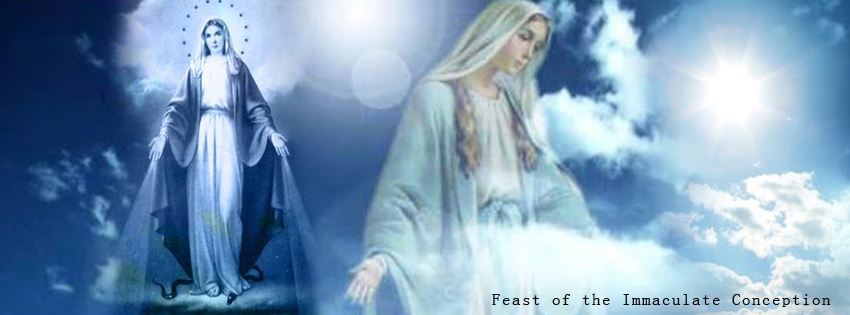
“We declare, we pronounce, and we define that the doctrine which holds that the most Blessed Virgin Mary, in the first instance of her conception, by a singular privilege and grace granted by Almighty God, in view of the merits of Jesus Christ, the Savior of the human race, was preserved free from all stain of original sin, is a doctrine revealed by God and therefore to be believed firmly and constantly by all the faithful.”
The 8th of December is an important day - the Feast of the Immaculate Conception. It is also the day on which in 1947 Our Blessed Mother gave us the Hour of Grace.
Our Lady said as follows when she appeared to Sister Pierina in a little church in Montichiari, Italy: "It is my wish that every year, on 8th December, at noon, the HOUR OF GRACE FOR THE WORLD be celebrated. Many divine and bodily graces will be received through this devotion. Our Lord, my Divine Son Jesus, will send His overflowing mercy if good people will pray continuously for their sinful brother.... it is my wish that the HOUR OF GRACE FOR THE WORLD be made known and spread throughout the world. If anyone is unable to visit his church, yet will pray at home, he will also receive graces through me.... will find a secure heavenly ladder and receive protection and grace through my motherly heart."
THE REQUEST OF OUR BLESSED MOTHER FOR THE HOUR OF GRACE:
Our Lady promised she will hear any prayer we make at this time.
1. Day and time of the Hour of Grace: December 8th, Feast of the Immaculate Conception, to be started at 12:00 noon and continuing until 1:00 p.m. for one full hour of prayer.
2. During this hour, the person making the Hour of Grace either at home or at church must put away all distractions (do not answer the telephones, or answer any doors, or do anything but totally concentrate on your union with God during this special Hour of Grace).
3. Begin the Hour of Grace by praying three times the 51st Psalm with out-stretched arms. (Psalm 51 appears below).
4. The rest of the Hour of Grace may be spent in silent communication with God meditating upon the Passion of Jesus, saying the Holy Rosary, praising God in your own way, or by using favourite prayers, singing hymns, meditating upon other psalms, etc.
Psalm 51
1 Have mercy on me, O God, according to Your unfailing Love; according to Your great Compassion blot out my transgressions. 2 Wash away all my iniquity and cleanse me from my sin. 3 For I know my transgressions, and my sin is always before me. 4 Against You, You only, have I sinned and done what is evil in Your Sight; so You are right in Your verdict and justified when You judge. 5 Surely I was sinful at birth, sinful from the time my mother conceived me. 6 Yet You desired faithfulness even in the womb; You taught me wisdom in that secret place. 7 Cleanse me with hyssop, and I will be clean; wash me, and I will be whiter than snow. 8 Let me hear joy and gladness; let the bones You have crushed rejoice. 9 Hide Your Face from my sins and blot out all my iniquity. 10 Create in me a pure heart, O God, and renew a steadfast spirit within me. 11 Do not cast me from Your Presence or take Your Holy Spirit from me. 12 Restore to me the joy of Your Salvation and grant me a willing spirit, to sustain me. 13 Then I will teach transgressors Your Ways, so that sinners will turn back to You. 14 Deliver me from the guilt of bloodshed, O God, You who are God my Savior, and my tongue will sing of Your righteousness. 15 Open my lips, Lord, and my mouth will declare Your praise. 16 You do not delight in sacrifice, or I would bring it; You do not take pleasure in burnt offerings. 17 My sacrifice, O God, is a broken spirit; a broken and contrite heart You, God, will not despise. 18 May it please You to prosper Zion, to build up the walls of Jerusalem. 19 Then You will delight in the sacrifices of the righteous, in burnt offerings offered whole; then bulls will be offered on Your altar.