On January 31 the Church honors the Memorial of St. John Bosco-Friend of the
Youth. He was called "Apostle of Youth" because he dedicated his life to the
young people by organizing youth clubs, hostels, and boarding schools where he
taught them. He founded the Salesian Society for the boys in 1854 which was
named St. Francis de Sales. In 1872 he also founded the Salesian Sisters called
Daughters of Mary, Help of Christians to work for
girls. St. John Bosco had no formal system or theory of
education. His methods centered on persuasion, authentic religiosity, and love
for young people. He was an enlightened educator and innovator. The educational
philosophy of John Bosco can be condensed in three words: reason, religion, and
kindness. The basic principle of his system was a deep understanding and love
for young people and their problems.
Saint of the WeekJanuary 31 St. John Bosco is considered as the saint
of the youth. Founder of Salesian Society, named in honor of St. Francis de
Sales. His lifework was the welfare of young boys and girls, hence his title,
"Apostle of Youth." His methods centered on persuasion, authentic religiosity,
and love for young people. He was an enlightened educator and innovator. Pope
John Paul II named him "teacher and father to the
young." At age 14, he really wanted to be a priest
because he wants the youth to understand their faith. He served a priest for its
morning masses and the priest taught John Bosco Latin. But the young John Bosco
needed to stop his lessons with the priest because he needed to work in a farm
to help their family for a living. But he did not stop dreaming of becoming a
priest until one day his uncle brought him to a school where he can fulfill his
dream.
Don Bosco was first and foremost a priest. Whatever priestly work needed doing and came to his hand he did, whether it was saving some poor waif off the streets of Turin or conducting delicate negotiations between the Vatican and the government for the appointment of bishops to the vacant Italian sees. So greatly in fact had the influence of this peasant priest from Becchi grown that he was called on to act as intermediary in this important matter. He consented to do so, as he told the President of the Council at Florence, solely as a priest — "Priest at the altar, priest in the confessional, priest among my boys, and priest in the king's palace or his ministers' offices: I will be nothing but a priest." ~ Lancelot C. Sheppard, Don Bosco's biographer
He is a patron saint of apprentices; boys;
editors; young people; laborers; students and young
people. To know more about St. John Bosco, please click
on the following links:
Faithful Catholics: Pray More and Complain Less,
A Message of Hope
Dear Catholic Friend,
I am writing to you to give you a word of encouragement. So I would hope you take this in the fatherly way I want to address you, as one who is a priest of over 32 years and as spiritual director of dozens of people, a priest who very much has personal contact with many of the lay faithful and knows very well the deep concern – anxiety may be a better word – over the present situation in the Church. Take this as if I were in your presence, saying firmly and clearly and with great confidence: Be at peace! Pray more! Calm down and don’t lose heart!
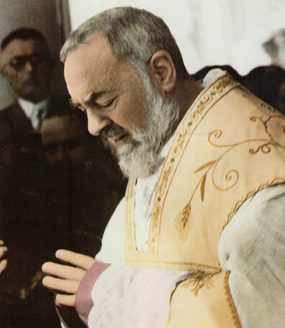
Padre Pio is quoted as saying, “Pray, hope, and don’t worry!” I want to aim that especially at people who write those anxiety-filled blogs and articles at the Church’s present situation, but certainly to all the Catholic faithful who are confused, bemused, or just plain angry. I certainly understand your concern; in fact, I share it but my consideration as to what to do is different. I conclude that we should pray more and complain less; besides you might recall the words of Psalm 95 which we priests and religious who recite the Divine Office have the joy of choosing as the invitatory psalm in our daily recitation of the breviary; specifically the verse that says: “Forty years I endured that generation. I said, ‘They are a people whose hearts go astray and they do not know my ways.’ So I swore in My anger, ‘They shall not enter into My rest.’”
What Are You Going to Do?
Let’s not try our Lord’s patience, rather let’s take this as an opportunity to establish a firmer faith, a more secure hope and a deeper charity. After all, what are you going to do? Leave the Church?! Wouldn’t the Evil One then have the victory over your soul?
Think of it! Aren’t you one who loves that old title given to us at confirmation, “soldiers of Christ.” Well, then don’t walk off the field of battle. These are the times, I’m convinced, that St. Louis Marie de Montfort prophesied, the time of the great saints: “Towards, the end of the world . . . Almighty God and His holy mother are to raise up great saints who will surpass in holiness most other saints as much as the cedars of Lebanon tower above little shrubs.” (St. Louis Marie de Montfort, True Devotion to Mary, article 47). Take it a s a compliment that our father God finds you worthy of these times, that He finds you capable of great sanctity!
I write as one who gives direction to many souls and who is alarmed at the discouragement that has entered so many hearts. I hear it and see it a lot and I must confess that discouragement is not foreign to me, especially given the confusion spread even by those called to strengthen our faith. That being said, I want to tell you what I tell the souls entrusted to me: Pray more! Pray for an increase of faith, hope, and love and make it an apostolic prayer, said with missionary zeal for the sake of others. “Father, Son, and Holy Spirit, increase our faith, hope and love!” Not just once, but many times a day, pray this way and you will fulfill your duty as a good soldier of Christ.
Hang in There Friends!
I write this out of gratitude for all the Catholic faithful whose loyalty to Christ and His holy Church has inspired me throughout my life. Hang in there friends! Hang in there with greater faith, hope, and love. “The gates of Hell will not prevail!”
May holy Mary, the woman of great faith and mother of the Church, envelop you in Her most compassionate and immaculate heart. Peace!
The
Week of Prayer for Christian Unity lasts from January 18th until
January 25th and is a time when Christians of all stripes are called
to pray for the unity of the Church. Pope Leo XIII had asked for
Catholics to pray for Christian unity and in 1897 established the
continual recitation
of a novena. The actual dates of the week of prayer were established by
Spencer Jones, an Anglican priest and Lewis Wattson, an Episcopal priest
who later converted to Catholicism.
They suggested the dates of January 18-25 to begin with the old date
of the Confession (or Chair) of St. Peter and end on the Conversion of
St. Paul, holy days within the Church year. Pope Pius X approved the new
octave and extended its observance throughout the whole of the
Catholic Church. Paul Couturier, a Frenchman, is well known for
popularizing the week. The links below explain more of the history of
the octave and served as sources for this brief introduction.
A Brief History of the Week of Prayer Another Brief History
We believe the best way to achieve unity between Orthodox and
Catholics is twofold: prayer and mutual understanding. This is also how
we will accomplish greater unity with our Protestant brothers and
sisters. On Ancient and Future Catholics we have always worked towards
mutual understanding and now we want to make prayer for visible
unity another primary focus. What better
way to achieve that goal than to start with the octave of Christian
unity? We have several suggestions for these 8 days. The first obvious
activity is prayer. Each day we will post prayer suggestions, but above
all, we must pray for visible unity between the Orthodox and Catholic
Churches, and with other churches as well. Secondly, we will provide a
reading from both Eastern and Western Christian writers. This purpose is
to help each side become more acquainted with the riches involved in
the Western and Eastern heritage. This will also include liturgical
texts. Finally, we will give practical suggestions for better relations
with individual Orthodox and Catholics, principles which apply also to
our relationships with Protestants. Although we are primarily focusing
on Catholic-Orthodox relations, our secondary focus will be prayer for
the unity of all Christians and the conversion of non-Christians. This
effort is not officially associated with any diocese or parish and we
are loyal to the Magisterium and our bishops.
We are simply laymen trying to live out our faith.
So, starting on January 18th, please join us and the Catholic Church
as we pray that all Christians, by God's grace, may be one as our
Lord prayed before his Passion.
The Holy Family is the name given to the family unit of Jesus: The
Divine Son of God Jesus, his mother the Virgin Mary, and his
foster-father Joseph. We know very little about the life of the Holy
Family through the canonical Gospels. They speak of the early years of
the Holy Family, including the birth of Jesus in Bethlehem, the flight
into Egypt, and the finding of Jesus in the temple. Various
non-canonical works, including the
Infancy Gospel of Thomas,
try to fill in the blanks. However, even though these apocryphal works
may contain some truth derived from oral tradition, they have been
deemed unworthy of canonical status because of the way they present
Jesus. While the exact details of the day-to-day life of the Holy Family
may be unknown, we can still learn a lot from the stories we do have.
Devotion to the Holy Family is a recent development, but one that
naturally grows out of a love for Jesus and his family. The cult of the
Holy Family grew in popularity in the 17th century, and several
religious congregations have been founded under this title. The Holy
Family also became portrayed in popular art of the period. On October
26, 1921 the Congregation of Rites (under Pope Benedict XV) inserted the
Feast of the Holy Family into the Latin Rite general calendar. Until
then it had been celebrated regionally (see History below). Popes before
and including Benedict XV (especially Leo XIII) promoted the feast as a
way to counter the breakdown of the family unit. Today the Church
celebrates the Feast on the Sunday between Christmas and New Year's Day
(Known as the Feast of Mary Mother of God in the Catholic Church). If
both Christmas and New Year's Day fall on Sundays, no Sunday exists
between the two dates, so the Church celebrates the Holy Family Feast on
December 30th. If the feast falls on the 30th, attendance is not
obligatory. Up until 1969, the Holy Family feast was kept on the first
Sunday after the Epiphany. It was transferred to its current date in 1969.
The Feast of the Holy Family is not just about the Holy Family, but
about our own families too. The main purpose of the Feast is to present
the Holy Family as the model for all Christian families, and for
domestic life in general. Our family life becomes sanctified when we
live the life of the Church within our homes. This is called the
"domestic church" or the "church in miniature." St. John Chrysostom
urged all Christians to make each home a "family church," and in doing
so, we sanctify the family unit. Just how does one live out the Church
in the family? The best way is by making Christ the center of family and
individual life. Ways to do this include: reading scripture regularly,
praying daily, attending Mass at least on Sundays and Holy Days of
Obligation, imitating the actions of the Holy Family, going to
confession frequently, and so forth, all done together as a family unit. In addition to cultivating positive actions, the Church understands
that various actions and behaviors are contrary to God's
Divine plan for
the family. These include abortion, contraception, embryonic stem-cell
research, divorce, spousal abuse, child abuse, among other things.
Catholic Teaching is that a marriage must be open to children. Anything
artificial that prevents this is contrary to divine law, although
spacing births for a just reason is permitted (and may be accomplished
through "natural family planning").
Also, poverty, lack of health care, rights violations, government
intrusion in the life of communities and families, and other justice
concerns must be addressed by faithful Christians because of the
negative effect these conditions have on the family unit. St. Paul gives
us some advice on family life in Colossians 3:12-21:
Put on then, as God's chosen ones, holy and beloved,
compassion, kindness, lowliness, meekness, and patience, forbearing one
another and, if one has a complaint against another, forgiving each
other; as the Lord has forgiven you, so you also must forgive. And above
all these put on love, which binds everything together in perfect
harmony. And let the peace of Christ rule in your hearts, to which
indeed you were called in the one body. And be thankful. Let the Word of
Christ dwell in you richly, teach and admonish one another in all
wisdom, and sing psalms and hymns and spiritual songs with thankfulness
in your hearts to God. And whatever you do, in word or deed, do
everything in the Name of the Lord Jesus, giving thanks to God the
Father through Him. Wives, be subject to your husbands, as is fitting in
the Lord. Husbands, love your wives, and do not be harsh with them.
Children, obey your parents in everything, for this pleases the Lord.
Fathers, do not provoke your children, lest they become discouraged
(RSV).
The Holy Family feast is a good time to remember the family unit and
pray for our human and spiritual families. We also may take this feast
to reflect on the value and sanctity of the family unit, and to evaluate
our own family life. What ways may it be improved? What would Jesus,
Mary, and Joseph do? Finally, we can use this feast to ask ourselves
what are we doing to promote the family within our own cultures,
neighborhoods, and communities.
Prayer in Honor of the Holy Family
Lord Jesus Christ,
Who, being made subject to Mary and Joseph,
didst consecrate domestic life
by Thine ineffable virtues;
grant that we,
with the assistance of both,
may be taught by the example
of Thy Holy Family
and may attain to its everlasting fellowship.
Who livest and reignest forever. Amen.
This week we were discussing the history of the Thanksgiving Holiday as we
celebrate it in the United States. One interesting thing we discovered is that
the U.S History each of us learned was quite different. In fact one of our
sisters had almost no teaching of any "religious" roots in the founding of many
of the original colonies. Due to this we thought it might be of interest to give
a (very) short history of some of our country's Thanksgiving celebrations.
Many of us in America think of our "first thanksgiving" as being the one
celebrated by the pilgrims in Plymouth in 1621. (This feast lasted 3 days and
was attended by 53 Pilgrims and 90 Native Americans.)
What we may not realize is that the traditions of having" thanksgivings"
-days of prayer to thank God for the blessings of ending droughts, granting
military victories or the more common custom of thanking God for blessings of
the harvest were actually recorded in many areas much earlier. We list just a
few for those who might enjoy a bit of history.
At the time when "British America" included not only the American colonies
but parts of Canadian territory, there was a celebration of a thanksgiving feast
at Frosbisher Bay in 1578. This is considered to be the first thanksgiving on
Anglo American soil and provides the basis for today's Canadian Thanksgiving
Holiday.
Celebrations in the territory now considered to be the United States occurred
in Spanish territory in the 16th century, and were routine in Virginia with
Jamestown holding one in 1610 and by charter holding "that there shall be yearly
and perpetually kept holy a day of thanksgiving to Almighty God."
The First National Proclamation of Thanksgiving was given by the Continental
Congress in 1777. In 1789 President George Washington proclaimed and created the
first Thanksgiving Day designated by the national government of the United
States of America.
We thank God for his blessings and that he will continue to pour out his
blessings on us. We leave you with the words of George
Washington:
Whereas it is the duty of all Nations to acknowledge the providence
of Almighty God, to obey his will, to be grateful for his benefits, and humbly
to implore his protection and favor, and whereas both Houses of Congress have by
their joint Committee requested me "to recommend to the People of the United
States a day of public thanksgiving and prayer to be observed by acknowledging
with grateful hearts the many signal favors of Almighty God especially by
affording them an opportunity peaceably to establish a form of government for
their safety and happiness." Now therefore I do recommend and assign Thursday
the 26th day of November next to be devoted by the People of these States to the
service of that great and glorious Being, who is the beneficent Author of all
the good that was, that is, or that will be. That we may then all unite in
rendering unto Him our sincere and humble thanks, for His kind care and
protection of the People of this Country previous to their becoming a Nation,
for the signal and manifold mercies, and the favorable interposition's of His
providence, which we experienced in the course and conclusion of the late war,
for the great degree of tranquility, union, and plenty, which we have since
enjoyed, for the peaceable and rational manner, in which we have been enabled to
establish constitutions of government for our safety and happiness, and
particularly the national One now lately instituted, for the civil and religious
liberty with which we are blessed; and the means we have of acquiring and
diffusing useful knowledge; and in general for all the great and various favors
which He hath been pleased to confer upon us. And also that we may then unite in
most humbly offering our prayers and supplications to the great Lord and Ruler
of Nations and beseech Him to pardon our national and other transgressions, to
enable us all, whether in public or private stations, to perform our several and
relative duties properly and punctually, to render our national government a
blessing to all the people, by constantly being a Government of wise, just, and
constitutional laws, discreetly and faithfully executed and obeyed, to protect
and guide all Sovereigns and Nations (especially such as have shown kindness
unto us) and to bless them with good government, peace, and concord. To promote
the knowledge and practice of true religion and virtue, and the increase of
science among them and us, and generally to grant unto all Mankind such a degree
of temporal prosperity as He alone knows to be best. Given under my hand at the
City of New York the third day of October in the year of our Lord
1789.
Many thanks to:
The Poor Clare Sisters of Spokane
Franciscan Monastery of Saint Clare
4419 N Hawthorne St
Spokane, WA 99205, USA
The word Eucharist comes from the Greek word for Thanks. The original and only perfect Thanksgiving Meal is the Holy Eucharist. (The Holy Thanksgiving)
America is one out of many nations that celebrates a Thanksgiving Day. The Catholic Church celebrates it in every nation on earth every day, everywhere Holy Mass is celebrated. You are all invited to this Holy Meal to give thanks to Jesus for His Holy Sacrifice at that meal. Malachi prophesied it in the Old Testament. My Name will be great among the Gentiles for a perfect sacrifice will be offered in My Name from the rising of the son til the going down there of. Every minute of every hour, of every day, that Holy Thanksgiving sacrifice is offered for all mankind. Don't miss out being there on this special day of Thanksgiving.
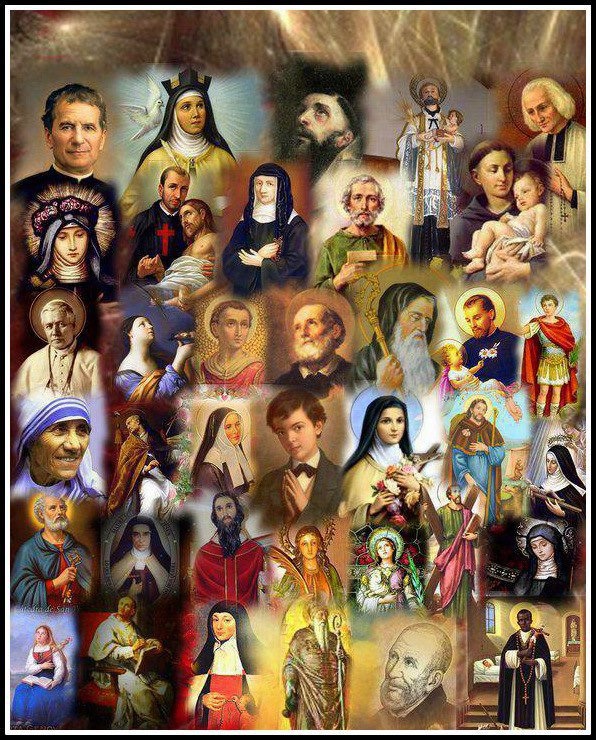
Every day in the Church year has a saint day, but the Solemnity of All Saints
is when the Church honors all saints, known
and unknown. This is
similar to the American holidays of Veterans Day and Presidents Day,
when a group of people are honored on a specific day. While we have
information about many saints, and we honor them on specific days, there
are many unknown or unsung saints, who may have been forgotten, or
never been honored specifically. On All Saints Day, we celebrate these
holy men and women, and ask for their prayers and intercessions.
The concept of All Saints Day is connected to the doctrine of The Communion of Saints. This is the concept that all of God's people, on heaven, earth, and in the state of purification (called Purgatory
in the West), are spiritually connected and united. In other words,
Catholic and Orthodox Christians (and some Protestants) believe that the
saints of God are just as alive as you and I, and are constantly
interceding on our behalf. Remember, our connection with the saints in
heaven is one grounded in a tight-knit communion. The saints
are not divine, nor omnipresent or omniscient. However, because of our
common communion with and through Jesus Christ, our prayers are joined
with the heavenly community of Christians. St. Cyril of Jerusalem (AD
350) testifies to this belief:
We mention those who have fallen asleep: first the patriarchs, prophets,
apostles, and martyrs, that through their prayers and supplications God
would receive our petition...(Catechetical Lecture 23:9).
The Catholic Catechism concisely describes this communion among
believers, by which we are connected to Christ, and thus to one another:
"Being more closely united to Christ, those who dwell in heaven fix the
whole Church more firmly in holiness...They do not cease to intercede
with the Father for us...So by their fraternal concern is our weakness
greatly helped."
"...as Christian communion among our fellow pilgrims brings us closer to
Christ, so our communion with the saints joins us to Christ, from whom
as from its fountain and head issues all grace, and the life of the
People of God itself: We worship Christ as God's Son; we love the
martyrs as the Lord's disciples and imitators, and rightly so because of
their matchless devotion towards their king and master. May we also be
their companions and fellow disciples (
CCC956, 957)!
There are thousands of canonized saints,
that is those individuals officially recognized by the Church as holy
men and women worthy of imitation. Because miracles have been associated
with these people, and their lives have been fully examined and found
holy by the Church, we can be assured they are prime examples of
holiness, and powerful intercessors before God on our behalf. There are
also many patron saints, guardians or protectors of different areas and
states of life. For instance, St. Vitus is the patron saint against
oversleeping, and St. Joseph of Cupertino is the patron saint of air
travelers. It may sound crazy to have a patron saint against
oversleeping, but keep in mind the Church has something meaningful for every
area of our human lives. All of these saints are celebrated throughout
the year, as many have their own feast days (for instance, St. Hilary of
Poitiers, whose feast day is celebrated January 13).
History
Christians have been honoring saints and martyrs since at least the second century AD. The Martyrdom of Polycarp, probably written near the middle of the second century, attests to this reality:
Accordingly, we afterwards took up his bones, more precious than the
most exquisite jewels, and more pure than gold, and deposited them in a
fitting place, so that when being gathered together, as opportunity is
allowed us, with joy and rejoicing, the Lord shall grant us to celebrate
the anniversary of his martyrdom, both in memory of those who have
already finished their course, and for the exercising and preparation
of those yet to walk in their steps (18).
Initially the calendars of saints and martyrs varied by location,
with churches honoring local saints. However, gradually feast days
became more universal. The first reference to a general feast
celebrating all saints occurs in St Ephrem the Syrian (d. AD 373). St.
John Chrysostom (d. AD 407) assigned a day to the feast, the first
Sunday after Pentecost, where in the Eastern Churches the feast is
celebrated to this day. In the West, this date was probably originally
used, and then the feast was moved to May 13th. The current observance
(November 1) probably originates from the time of Pope Gregory III (d.
AD 741), and was likely first observed on November 1st in Germany. This
fact makes the connection of the All Saints Feast with the pagan
festival Samhain less likely, since Samhain was an Irish pagan feast, rather than German.
The vigil of the Feast (the eve) has grown up in the English speaking countries as a festival in itself, All Hallows Eve,
or Halloween. While some Christians refuse to observe the holiday,
considering it to be "pagan," as far as the Church is concerned, the
date is simply the eve of the feast of All Saints. Many customs of
Halloween reflect the Christian belief that on the feast's vigils we
mock evil, because as Christians, it has no real power over us. David
Morrison explains the proper relationship between Christians and Halloween.
Various customs have developed related to Halloween. In the Middle
Ages, poor people in the community begged for "soul cakes," and upon
receiving these doughnuts, they would agree to pray for departed souls.
This is the root of our modern day "trick-or-treat." The custom of masks
and costumes developed to mock evil and perhaps confuse the evil
spirits by dressing as one of their own. Some Christians visit
cemeteries on Halloween, not to practice evil, but to commemorate
departed relatives and friends, with picnics and the last flowers of the
year. The day after All Saints day is called All Soul's Day,
a day to remember and offer prayers up on behalf of all of the faithful
departed. In many cultures it seems the two days share many customs.
See the Oxford Dictionary of the Christian Church for more information.
St. Teresa was born in Avila, Spain, on March 28, 1515. As a little girl in her parents' rich home, Teresa and her brother Rodrigo loved to read the lives of the saints and martyrs. It seemed to them that the martyrs got to heaven an easy way. The two children set out secretly to go to the land of the Moors. As they walked along, they prayed that they might die for Christ. But they had not gotten far when they met an uncle. He took them back to their worried mother at once. Next the children decided to be hermits in their garden. This didn't work out either. They could not get enough stones together to build their huts.
St. Teresa herself wrote down these amusing stories of her childhood. The fact is that when she grew to be a teenager, however, she changed. Teresa read so many novels and foolish romances that she lost much of her love for prayer. She began to think more of dressing up to look pretty. But after she recovered from a bad illness, Teresa read a book about the great St. Jerome. Then and there, she made up her mind to become a bride of Christ. As a nun, Teresa often found it hard to pray. Besides that, she had poor health.
Teresa wasted time every day in long, foolish conversations. But one day, in front of a picture of Jesus, she felt great sorrow that she did not love God more. She started then to live for Jesus alone, no matter what sacrifice had to be made. In return for her love, the Lord gave St. Teresa the privilege of hearing him talk to her. She learned to pray in a marvelous way, too. St. Teresa of Avila is famous for having opened new Carmelite convents. These convents were filled with sisters who wanted to live holy lives. They made many sacrifices for Jesus. Teresa herself gave them the example. She prayed with great love and worked hard at the convent tasks. St. Teresa was a great leader and true lover of Jesus and his Church. She died in 1582 and was proclaimed a saint by Pope Gregory XV in 1622. She was declared a Doctor of the Church by Pope Paul VI in 1970. She is remembered on October 15th.
One of her prayers:
Lord,
Thou knowest better than I myself
that I am growing older and will someday be old.
Keep me from the fatal habit of thinking
I must say something on every subject and on every occasion.
Release me from craving to
straighten out everybody’s affairs.
Make me thoughtful but not moody;
helpful but not bossy.
With my vast store of wisdom,
it seems a pity not to use it all;
but Thou knowest, Lord,
that I want a few friends at the end.
Keep my mind free from the recital of endless details;
give me wings to get to the point.
Seal my lips on my aches and pains;
they are increasing, and love of rehearsing them
is becoming sweeter as the years go by.
I dare not ask for improved memory,
but for a growing humility and a lessening cock-sureness
when my memory seems to clash with the memories of others.
Teach me the glorious lesson that occasionally I may be mistaken.
Keep me reasonably sweet, for a sour old person
is one of the crowning works of the devil.
Give me the ability to see good things in unexpected places
and talents in unexpected people;
and give, O Lord, the grace to tell them so.
Amen.
This week has long been one of my favorites in the church year. Who
can resist the sweetness, purity, power and goodness of all these saints
and angels celebrated in one week!
September ends with the celebration of the great heavenly warrior St
Michael, and he is followed a day later by St Therese of Lisieux who
everybody loves. Then as if to celebrate her Little Way of spiritual
childhood further we pile on the Feast of the Holy Guardian Angels, then
a day later more super attractive sweetness in St Francis of Assissi.
Michael, Therese, Guardian Angels, Francis… it’s almost too much for
those who love the Lord and love his saints.
But hang on. Stuck there between St Michael and St Therese is Jerome.
Jerome? Jerome the patron saint of curmudgeons? Jerome the misogynist
grump? Jerome the not politically correct, intellectual who didn’t do
small talk and was (to put it mildly) not inclined to suffer fools
gladly?
That’s right. Jerome. Saint Jerome.
Born around the year 340 Jerome began a scholarly life from an early age.
He studied at Rome and Trier, retired to the desert to live in a cave,
made friends with St Gregory Nanzianzus, Pope Damasus and at the same
time made lots of enemies. He not only translated the Bible into Latin,
but wrote controversial essays, theological works and was a translator.
He ended up living as a monk in Bethlehem, dying at the age of 80.
Jerome was kind of like the Michael Voris of his age. He attacked
just about everybody for anything. He was at heart an extremist, a
radical ascetic and a recluse. We must remember that in the late fourth
century Christianity had become the official religion of the Roman
Empire. The early days of austerity, persecution and being an
underground movement were over and the church had to cope now with the
problems of worldliness.
So Jerome wrote of the nice, Christian, but worldly matrons who
“paint their cheeks with rouge and their eyelids with antimony, whose
plastered faces, too white for human beings, look like idols; and if in a
moment of forgetfulness they shed a tear it makes a furrow where it
rolls down the painted cheek; women to whom years do not bring the
gravity of age, who load their heads with other people’s hair, enamel a
lost youth upon the wrinkles of age, and affect a maidenly timidity in
the midst of a troop of grand children.”
He also didn’t have much time for poncy clergy who fuss over their
clothes. In a letter to Eustochium he writes with scorn of certain
members of the Roman clergy. “All their anxiety is about their clothes….
You would take them for bridegrooms rather than for clerics; all they
think about is knowing the names and houses and doings of rich ladies.”
Indeed. They are with us today–cissy priests who spend all their time
fussing over pretty vestments.
Jerome’s style was caustic, sarcastic and harsh so he made lots of
enemies. They returned the attacks, gossiping about his relationship
with the holy women who surrounded him, mocking his gait, his smile and
his accomplishments.
So he left Rome and headed for Bethlehem where he lived in a cave,
opened a monastery for men and three communities of women. His friend
Paula became head of one of these, and after her death was succeeded by
her daughter Eustochium. Jerome himself lived and worked in a large cave
near the Saviour’s birthplace. He opened a free school there and also a
hospice for pilgrims, “so that,” as Paula said, “should Mary and Joseph
visit Bethlehem again, they would have a place to stay.”
From his cave he continued his intellectual battles: he argued with
Heldivius and Jovinian’s ideas that the Blessed Virgin had other
children by Joseph. He combatted a monk Vigilantius who was down on the
veneration of relics and celibacy and even crossed swords with
Augustine.
Excuse me for loving the great St Jerome. Maybe it
is the monk in me, the recluse, the bookish hermit in me that would also
like to retire to a cave somewhere, but Jerome reminds us that “the
church of nice” isn’t the only way. Jerome rightly warns us against
worldliness, sentimentality, intellectual shallowness and cowardice. He
reminds us to fight the good fight with all our might, and if he
descended into sarcasm and satire, he was also always aware of his own
weakness, temptation and soiled humanity. The fact that Jerome is plonked down right there between the angels,
Therese and Francis reminds us that the army of saints needs little
flowers and holy friars who preach to birdies, but it also needs saints
with True Grit.
We need some Rooster Cogburn Catholics as well as the sweet little girls, the angels and the beautiful foolish dreamers.
And while I love this holy week in the beginning of October, that is
the down side: the sweet angels with their girly faces, simpering
Therese smiling from her little girl photographs and holy St Francis
taming the wolf of Gubbio or standing in the snow–this all appeals to
the sentimentalists. It’s greeting card Christianity…all twee and tacky
and gooey and sweet. Of course those who have ever met an angel know
they are far from the feminine looking creatures with long hair and
pretty wings so popular in Christian art. Those who know St Therese
realize that the little flower was also a little warrior and that she
would have gladly gone to live in a cave next to Jerome. Likewise,
anyone who knows St Francis realizes that his asceticism and severity
would have been right up there with Jerome’s.
That’s why Jerome’s curmudgeonly style is just the spice we need in
the midst of this week’s sweetness. He gives some salt in the dish to
accent the sugar. He adds some bite to the battle and gives a boost to
all those who wade in to counter the worldliness, foolishness and
trumpery of the world. He reminds us that we need prophetic voices in
the church to call a spade a spade. He reminds us that we need scholars
who are saints and saints who are scholars.
Each one of the saints reveals a vital aspect of Christ the Lord.
If St Francis reminds us of Jesus’ gentleness and love of poverty, and
if Therese reminds us of his love of children and the need to become
like little children, Jerome reminds us of the Lord’s intellectual
acuity, his sharp tongue, his willingness to be controversial for the
sake of truth and his ability to cut straight to the point, criticize
the religious hypocrites and live a radical life devoted to God alone.
Long live the curmudgeons and praise God for Jerome!
This article originally appeared on Fr. Dwight Longenecker’s blog “Standing on My Head,” and is reprinted with permission. Visit his website, browse his books, and be in touch at dwightlongenecker.com.