Thursday, April 11, 2013

Words of Jesus on suffering -The reason for suffering


 Words of Jesus to St Gemma -The reason for suffering and her share in the Sacred Passion
--Gemma's reply of love

Jesus says to Gemma: "When I shall be a spouse of blood to you, I will love you, but you must be as one crucified. Prove your love for Me as I have proved My love for you; and do you know how? -By suffering pains and crosses without number. You must consider yourself honoured when I treat you thus, and when I lead you through thorny and sorrowful paths. It is with My permission that the Devil torments you, that the world fills you with disgust, that the persons dearest to you cause you affliction. ... And you, My daughter, must think of only one thing during this time, that is, of exercising great virtues. Keep on the path of the Divine will, and humble yourself, and be convinced that if I nail you to the Cross, I love you."

"My daughter "-Jesus said to me- "if you truly love Me, you will love Me even in darkness. Embrace the Cross, My daughter, and be certain that whilst you are satisfying your desire of suffering you are satisfying My heart; and remember, the more bitter the Cross seems to your heart, the more agreeable it is to Mine."
And again Jesus has said to me: "Do you know why I desire to send crosses to the souls that are dear to Me? I desire to possess them entirely, and for that reason I surround them with crosses, and I shut them in with tribulations so that they may not escape out of My hands; for that reason I spread thorns everywhere so that giving their affections to no one they may seek all their pleasure in Me alone. My daughter, if the Cross was not felt, it could not be called a Cross. Be certain that if you stand beneath the Cross you will never be lost. The Devil has no power over those souls who weep near the Cross. My daughter, how many would have abandoned Me, if I had not crucified them. The Cross is a very precious gift, and many virtues can be learned through it."

And to this Gemma writes: ‘The Lord delights in playing with souls that are very dear to Him, but He plays with them because He loves them. Now He consoles them, now He allows them to become well esteemed by mankind, and afterwards He allows them to become a laughingstock to the world. At one time He makes them so courageous that Hell has no terrors for them, and at another time, He allows them to be frightened at the least thing. Whoever thinks that he is suffering, knows little; but whoever suffers and yet thinks that he suffers little or naught, is enlightened. Whoever is humiliated on earth, is in Heaven and on the Cross; whoever has the first place on earth, has the last before God. He who knows the Cross, desires it; he who does not know it, runs away from it.'
Gemma was meditating on and even living the Passion of Jesus Christ, and from this meditation she drew all her consolation. 'To meditate on Thy Passion, oh Jesus, has always been a great relief to holy souls.'
And this is how she wrote of the fruits she gathered from this meditation. 'Every day I make a meditation, but always on the Passion. If I did not do so, it would seem to me that Jesus would reprove me thus:

"See, My daughter, here I am on the Cross, through love, a victim for your many faults. Consider well My sufferings, and then deny Me, if you can, the tender compassion that I deserve.'


[All the quotations in the following section have been taken from the “Lettere ed estasi di Santa Gemma”.]

‘When I see Jesus weep, my own heart is transfixed with sorrow; I think . . . I think how I have by my sins caused some of the oppression which Jesus suffered in the Garden. At that time Jesus saw all my sins, all my omissions, and besides, He saw the place I should have occupied in Hell, if Thy Heart, oh Jesus, had not granted me pardon.'
‘When I am looking at the Crucifix, it seems to me that Jesus turns to me with words of reproof and says: 
"If you allow yourself to sin you will crucify Me anew. Are not these sufferings enough?" Mia Dio! After these words could I hold out any longer? But Jesus turning to me, very pleased, added and repeated: "Love Me as much as you can, and I shall give you all that you desire. Love Me with all your heart and I shall forgive you all your sins." -Oh the infinite goodness of Jesus! All He asks of me is love! '

‘Many times I have asked Jesus to teach me the true way of loving Him, and then Jesus allows me to see all His open Wounds, and that He says
: "Look, My daughter, look how I have suffered! Do you see this Cross, these nails, these thorns? They are the works of love. Look and learn how to love."


HEROIC RESOLUTIONS
The lessons which were taught in this school of love and suffering penetrated into the soul of the holy girl. The resolutions which she was thereby induced to make are among the most heroic that can be conceived, and the maxims she formulated almost divinely sublime.

‘I shall compensate Thee, oh Jesus, by treating myself as Thy slave, and by putting my shoulders under Thy Cross.'
‘Suffering will raise my spirits, and far from discouraging me will give me the strength necessary to correspond with Thy grace.'
‘Oh, how much I realize that by doing what the goodness of Jesus wills, every cross is changed into joy, suffering even becomes too pleasant! He has neither cross nor fear who is closely united with Jesus.'

‘My heart possesses Jesus and possessing Jesus I feel that I can smile even in the midst of so many tears. I feel, yes, I feel happy even in great suffering oh Jesus, whether Thou caresses me or strikes me, it is the same to me. Yea, when Thou dost strike me, I am all the more pleased, because it is really what I deserve.'
‘It ought not be that suffering should adapt itself to us, but we ought to adapt ourselves to suffering.'

‘Whoever loves Jesus has sufficient strength to suffer any cross whatsoever.'
‘Whoever truly loves, suffers gladly.'
‘The more a cross is contrary to my desires, the more it is like to Thine, oh Jesus.'
‘The masters of this world teach always with the voice, and You with suffering.'

‘Who knows how many would have abandoned Thee, if Thou had not held them to the Cross.'
‘ In loving it is Thou who delightest my soul, and in suffering it is I who delightest Thy Soul.'
'Why are you so afflicted, 0 my soul? You offend your Beloved if you do not embrace the Cross with gladness. If you do not send your thoughts to Calvary, you are not concerned about Paradise.'
‘Oh Jesus, You give crosses to those who love Thee! '
‘Oh Cross, when I am near thee I feel strong! '
'All my days are sown with crosses. Oh holy Cross, I have embraced thee! '
‘May my life be a continual sacrifice! May You increase my sufferings, my humiliations! '
‘If I had to live in the world without suffering I should say to Thee: "Let me rather die now. Either crucify my soul or make me die ! '


Upon hearing a cry like this-a cry that only the love of the Crucified could inspire, we shall now contemplate Gemma’s love for God:

TRANSPORTS OF LOVE FOR GOD
In a letter Gemma says- ‘Oh Passion of Christ! You Angels of Heaven, bow down with me in honour of the Passion of Jesus; together let us catch the Blood of Jesus! Passion of Jesus, I love Thee! Angels of Heaven, come, let us all adore the Passion of Jesus! '

‘How sweet and good Jesus is to me, in spite of my being so wicked! How shall I ever correspond with the mercy that Jesus shows me? What shall I give to Jesus in exchange for all the benefits He showers upon me?'
‘It is true, is it not, Jesus, that love is the best exchange for Thy gifts? And even I can love Thee. But I do not love Thee because of Thy gifts to me. I love Thee because Thou art my Jesus, I love Thee because Thou alone art worthy of being loved. I love Thee because Thou art good, because Thou hast promised, You have sworn never to abandon me....'

‘I love Thee because You are my benefactor, my preserver, because You consume my soul and make my soul divine. Because You are my Spouse, I seek Thee always, I seek Thy affection, Thy friendship, Thy glory.'

‘You ask me how I should like to love Thee? With that purity with which the virgins loved Thee; with that fortitude with which the martyrs loved Thee. Yes,... You know, 0 Jesus (but do I say it too often?), I want to love Thee as Thy holy Mother loved Thee.'
‘I should like to possess the purity of the Angels, and even that of our Mother, most holy Mary.'
‘Do You know what chastisement I fear to merit? It is that of being condemned not to love Thee any more, my Jesus.'

‘Love demands love, and fire calls upon fire--Even from the depths of my unworthiness I love Thee, 0 my Jesus, and intensely. It would be impossible for me not to think of Thee. . . . I spend my days uttering burning aspirations of love.'
‘But what do You call me? What do You say of me? I am Thy delight, 0 Jesus? I belong entirely to the Heart of Jesus; You are the staff of my life, the flame of my heart, the apple of my eye.'

‘See, Jesus, if You had shown Thyself less lovable; if You had not made me understand the extent of Thy love for me, I should have loved Thee less. But You have made me love Thee, and now I cannot do without Thee.'
‘What would happen to me if Jesus ceased to love me? I not to love Jesus, and Jesus not to love me? But it is a thought that terrifies me, and I beseech Jesus to continue to love me, to think of me, even though I do not succeed in loving Him as I ought.'
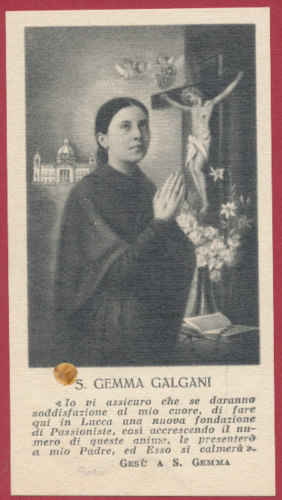

‘Oh dear Jesus, come to me, come! Do not be disgusted with my misery, for although it is great, Thy mercy is greater still. Come, and with Your purity, make my heart clean; with Thy meekness, beat down my pride. Visit my conscience, and if there is anything that displeases Thee, root it out and destroy it. Until my heart is full of true and solid virtue, do not come to it, do not expose to insult the honour of Thy glory, the greatness of Thy Majesty. Oh my God, You lower Thyself to the vilest of Thy creatures such as I am, repair the harm my sins have done, and raise me up, oh Jesus! And then, come to me always, oh Jesus....'

'I consider my soul as a high mountain with Jesus resting against it to prevent it from falling. Yes, it is indeed so! If Jesus did not sustain me I should fall. . . . 0 my God, make haste that I die, and die of love for Jesus! Do You not see that my heart and my body are in the throes of an agony and that I am on fire? Do You not see that I am a victim of love and that I shall soon die of love? The world wearies me; I long for one thing only, love, love, love.'

'What do You say, 0 Jesus? That when I am small then I am great? The smaller I feel, the more I feel I love Jesus. His love inebriates me, filling me ever more and more…I shall be alone with Jesus….What joy one experiences when one abandons oneself into the arms of Jesus! The faithful soul becomes His dearest child. He opens His arms to receive it, and presses it to His most Sacred Heart. Oh Jesus, I am in such need of Thy love!’


Source: "Blessed Gemma Galgani" by Father Amedeo C.P., Translated into English by Father Osmund Thorpe C.P., 1935.

Thursday, April 4, 2013

GoodBye Isn't Forever When You Step into Eternity


I don't really know how to begin this, I only know I have to write something about someone very dear to my heart that may soon step into eternity. Funny how you can become close with folks you meet online. A few commonalities and phone calls and you realize you have a soul mate that you'd have otherwise never met. Such is the case with my "hero"; Maddie. I won't identify her completely, but I will ask for your kind prayers for her ... just say Maddie, God knows her well! :) 

She's been living on 'borrowed time' for some time now. Cancer, among other maladies, has been her biggest cross. She's an animal lover and a people lover. She's led prayer groups even through her years of illness. She's offered many times to sit with folks she doesn't even know while they're getting their chemo treatments, even though she was currently undergoing her own treatments

Her Faith is phenomenal; and although she's had a few rough times and scares, it's been what's held her together. But it hasn't just held her together ... she has a peace and a joy that I can't even imagine under those circumstances. This is one of the reasons she will always be my "HERO"

Most recently, she's spent the better part of the last year in and out of hospitals with surgeries, chemo, radiation and other interventions caused by complications from the cancer. She's had sustained pain that most of us would faint from. Much of the cancer is in her lungs, but also went to the bones in the back of her neck to the spinal area and now it's spread to her brain. There's nothing more that can be done. No more chemo, no more radiation ... no more treatments. 

She will be going back to her home area from the treatment center in Texas and into a hospice for a last few months. Since I've known Maddie ... whenever we talk, it always pops up about how much she wants to hug Jesus :) We've also made a pact, that whoever gets there first will pray the other one there :) God can do anything of course, but it appears that she'll be taking the high road and getting there before me. 

The high road indeed. A while back, she'd asked Jesus to let her have her purgatory on earth ... I think He granted her that wish. Her son will be taking her back to LA next week. When she gets settled in, she will try to stay in contact on facebook as long as she can.

I wanted to write this to ask for prayers for her during the remainder of her time here on earth. She's assured me that the Doctors have said they can keep her comfortable as far as meds and pain goes now and the folks at the hospice will be kind and prayerful. There's a deacon there that she knows so that's nice and her son will be able to visit more. She will even get to visit with her pets a bit :) 

I believe with all my heart and soul that death is the beginning of the REAL LIFE we were meant to have. The eternity that God planned for us and Jesus redeemed us for through His Perfect Passion and Resurrection. But I can cry when I read a greeting card and since my own encounter with cancer and a hysterectomy, those emotions run even wilder than before; thankfully, she understands this too. You try to be strong for someone ... but most of my tears are cuz I'm amazed by her strength and peace and see the BEAUTY IN IT ALL

So this is a hard one for me 

The depth of her Faith and love of the Trinity and our Lady overwhelms me at times. Would that all just have half of what she's got; the world would be a much nicer place to be in till we get home. Jesus truly has given her His peace that goes beyond all understanding in this, praise be His Holy and Magnificent Name! 

So .. please keep Maddie in your kind prayers, even if she doesn't know you, somehow, I know that when she gets to heaven, she'll know who prayed for her and I can assure you that she will be most grateful and return those prayers without a doubt when you need them the most! So, when you see a cute animal, a beautiful sky, a gorgeous flower, think of my hero, Maddie and say a prayer for her please. 

Thursday, March 28, 2013

A certain Cardinal approved a certain Eucharistic Miracle .... Today, he's the Pope

Eucharistic Miracle in Buenos Aires

The weakening of faith in the real presence of the Risen Christ in the Eucharist is one of the most significant aspects of the current spiritual crisis. Jesus wants to strengthen our faith in His Eucharistic presence. That is why from time to time in the history of the Catholic Church He gives us signs–Eucharistic miracles that clearly underscore the fact that He, the Risen Lord Himself in the mystery of His Divinity and glorified humanity, is truly present in the Eucharist. The most recent Eucharistic miracle recognized by the Church authorities occurred in 1996 in the capital of Argentina–Buenos Aires.

A consecrated Host becomes flesh and blood
At seven o’clock in the evening on August 18, 1996, Fr. Alejandro Pezet was saying Holy Mass at a Catholic church in the commercial center of Buenos Aires. As he was finishing distributing Holy Communion, a woman came up to tell him that she had found a discarded host on a candleholder at the back of the church. On going to the spot indicated, Fr. Alejandro saw the defiled Host. Since he was unable to consume it, he placed it in a container of water and put it away in the tabernacle of the chapel of the Blessed Sacrament.

On Monday, August 26, upon opening the tabernacle, he saw to his amazement that the Host had turned into a bloody substance. He informed Cardinal Jorge Bergoglio, who gave instructions that the Host be professionally photographed. The photos were taken on September 6. They clearly show that the Host, which had become a fragment of bloodied flesh, had grown significantly in size. For several years the Host remained in the tabernacle, the whole affair being kept a strict secret. Since the Host suffered no visible decomposition, Cardinal Bergoglio decided to have it scientifically analyzed.

On October 5, 1999, in the presence of the Cardinal’s representatives, Dr. Castanon took a sample of the bloody fragment and sent it to New York for analysis. Since he did not wish to prejudice the study, he purposely did not inform the team of scientists of its provenance. One of these scientists was Dr. Frederic Zugiba, the well-known cardiologist and forensic pathologist. He determined that the analyzed substance was real flesh and blood containing human DNA. Zugiba testified that, “the analyzed material is a fragment of the heart muscle found in the wall of the left ventricle close to the valves. This muscle is responsible for the contraction of the heart. It should be borne in mind that the left cardiac ventricle pumps blood to all parts of the body. The heart muscle is in an inflammatory condition and contains a large number of white blood cells. This indicates that the heart was alive at the time the sample was taken. It is my contention that the heart was alive, since white blood cells die outside a living organism. They require a living organism to sustain them. Thus, their presence indicates that the heart was alive when the sample was taken. What is more, these white blood cells had penetrated the tissue, which further indicates that the heart had been under severe stress, as if the owner had been beaten severely about the chest.”

Two Australians, journalist Mike Willesee and lawyer Ron Tesoriero, witnessed these tests. Knowing where sample had come from, they were dumbfounded by Dr. Zugiba’s testimony. Mike Willesee asked the scientist how long the white blood cells would have remained alive if they had come from a piece of human tissue, which had been kept in water. They would have ceased to exist in a matter of minutes, Dr. Zugiba replied. The journalist then told the doctor that the source of the sample had first been kept in ordinary water for a month and then for another three years in a container of distilled water; only then had the sample been taken for analysis. Dr. Zugiba’s was at a loss to account for this fact. There was no way of explaining it scientifically, he stated. Only then did Mike Willesee inform Dr. Zugiba that the analyzed sample came from a consecrated Host (white, unleavened bread) that had mysteriously turned into bloody human flesh. Amazed by this information, Dr. Zugiba replied, “How and why a consecrated Host would change its character and become living human flesh and blood will remain an inexplicable mystery to science—a mystery totally beyond her competence.”

Only faith in the extraordinary action of a God provides the reasonable answer—faith in a God, who wants to make us aware that He is truly present in the mystery of the Eucharist.

The Eucharistic miracle in Buenos Aires is an extraordinary sign attested to by science. Through it Jesus desires to arouse in us a lively faith in His real presence in the Eucharist. He reminds us that His presence is real, and not symbolic. Only with the eyes of faith do we see Him under appearance of the consecrated bread and wine. We do not see Him with our bodily eyes, since He is present in His glorified humanity. In the Eucharist Jesus sees and loves us and desires to save us.

In collaboration with Ron Tesoriero, Mike Willesee, one of Australia’s best-known journalists (he converted to Catholicism after working on the documents of another Eucharistic miracle) wrote a book entitled Reason to Believe. In it they present documented facts of Eucharistic miracles and other signs calling people to faith in Christ who abides and teaches in the Catholic Church. They have also made a documentary film on the Eucharist—based largely on the scientific discoveries associated with the miraculous Host in Buenos Aires. Their aim was to give a clear presentation of the Catholic Church’s teaching on the subject of the Eucharist. They screened the film in numerous Australian cities. The showing at Adelaide drew a crowd of two thousand viewers. During the commentary and question period that followed a visibly moved man stood up announcing that he was blind. Having learned that this was an exceptional film, he had very much wanted to see it. Just before the screening, he prayed fervently to Jesus for the grace to see the film. At once his sight was restored to him, but only for the thirty-minute duration of the film. Upon its conclusion, he again lost the ability to see. He confirmed this by describing in minute detail certain scenes of the film. It was an incredible event that moved those present to the core of their being.

Through such wondrous signs God calls souls to conversion. If Jesus causes the Host to become visible flesh and blood, a muscle that is responsible for the contraction of a human heart—a heart that suffers like that of someone who has been beaten severely about the chest, if He does such things, it is in order to arouse and quicken our faith in His real presence in the Eucharist. He thus enables us to see that Holy Mass is a re-presentation (i.e. a making present) of the entire drama of our salvation: Christ’s passion, death, and resurrection. Jesus says to his disciples, “Unless you people see signs and wonders, you will not believe” (Jn 4: 48). There is no need to actively seek out wondrous signs. But if Jesus chooses to give them to us, then it behooves us to accept them with meekness and seek to understand what He desires to tell us by them. Thanks to these signs, many people have discovered faith in God—the One God in the Holy Trinity, who reveals His Son to us: Jesus Christ, who abides in the sacraments and teaches us through Holy Scripture and the Magisterium of the Catholic Church.
 
A mystery that surpasses our understanding
 The Eucharist—the actual presence of the risen person of Jesus under the appearances of bread and wine—is one of the most important and most difficult truths revealed to us by Christ. Eucharistic miracles are merely visible confirmations of what He tells us about Himself; namely, that He really does give us His glorified body and blood as spiritual food and drink.

Jesus established the Eucharist on the eve of His passion, death, and resurrection. During the Last Supper, He “took bread, said the blessing, broke it, and giving it to his disciples said, ‘Take and eat; this is my body.’ Then he took a cup, gave thanks,and gave it to them, saying, ‘Drink from it, all of you, for this is my blood of the covenant, which will be shed on behalf of many for the forgiveness of sins’” (Mat 26: 26-28). When Jesus took and gave the apostles the bread and wine, He said, “this is my body….this is my blood” by which He clearly meant that the bread and wine which He gave them to eat and drink really was His body and blood, and not some sort of symbol.

Earlier, in the famous Eucharistic sermon recorded by St. John the Evangelist, Jesus said to the Jews: “Amen, amen, I say to you, unless you eat the flesh of the Son of Man and drink his blood, you do not have life within you. Whoever eats my flesh and drinks my blood has eternal life, and I will raise him on the last day. For my flesh is true food, and my blood is true drink. Whoever eats my flesh and drinks my blood remains in me and I in him” (Jn 6: 53-56). Shocked by Jesus’ words, the Jews said, “How can this man give us his flesh to eat?” (Jn 6: 52). Many of Jesus’ disciples were also scandalized. “This saying is hard,” they objected, “who can accept it?” Knowing that the truth of the Eucharist was a shock and a scandal to many of His listeners, Jesus responded not by retracting His words, but by raising the stakes: “Does this shock you? What if you were to see the Son of Man ascending to where he was before? It is the spirit that gives life, while the flesh is of no avail. The words I have spoken to you are spirit and life”” (Jn 6: 62-63). Here Jesus goes to the heart of the mystery by anticipating the glorification of His humanity through His death, resurrection, and ascension. He will give His flesh and blood as food and drink after the Ascension; that is, when His flesh and blood have been glorified and divinized, for, unglorified, “flesh” is indeed “of no avail.”

Not all Jesus’ listeners accepted His teaching of the Eucharist. Thus He turned to them, saying, “‘But there are some of you who do not believe.’ Jesus knew from the beginning the ones who would not believe and the one who would betray him” (Jn 6: 65). Judas’ betrayal began with his rejection of Jesus’ teaching about His real presence in the Eucharist. In confirmation of this fact, Jesus said, “‘Did I not choose you twelve? Yet is not one of you a devil?’ He was referring to Judas, son of Simon the Iscariot; it was he who would betray him, one of the Twelve” (Jn 6: 70-71).
The Eucharist is the Risen Jesus Himself in His glorified, and thus invisible, humanity. This is the essence of His teaching of the Eucharist (Jn 6: 62-63). By its death and resurrection, the humanity of Jesus takes on a divine nature; it assumes a new order of existence: “For in him dwells the whole fullness of the deity, bodily” (Col 2: 9). In His glorified humanity, the Risen Jesus, becoming omnipresent, gives of Himself in the gift of the Eucharist. He shares with us His resurrected life and love that we may even here on earth experience the reality of heaven and partake of the life of the Holy Trinity.

Confronting the mystery of the Eucharist, human reason feels its impotence and limitations. In his encyclical devoted this sacrament, John Paul II writes: “‘The consecration of the bread and wine effects the change of the whole substance of the bead into the substance of the body of Christ our Lord, and of the whole substance of the wine into the substance of his blood. And the holy Catholic Church has fittingly and properly called this change transubstantiation.’ Truly the Eucharist is a mysterium fidei, a mystery which surpasses our understanding and can only be received in faith, as is often brought out in the catechesis of the Church Fathers regarding this divine sacrament: ‘Do not see—Saint Cyril of Jerusalem exhorts—in the bread and wine merely natural elements, because the Lord has expressly said that they are his body and his blood: faith assures you of this, though your senses suggest otherwise’” (Ecclesia de Eucharistia, 15).
The Eucharist is Christ’s supreme gift and miracle, for in it He gives us Himself and engages us in His work of salvation. He enables us to participate in His victory over death, sin, and Satan, share in the divine nature, and partake of the life of the Holy Trinity. In the Eucharist we receive “the medicine of immortality, the antidote to death” (EE, 18). For this reason, Mother Church holds that every deliberate and freely willed absence from Holy Mass on Sunday is an irretrievable spiritual loss, a sign of loss of faith, and hence a serious sin. Let us also remember that if “a Christian’s conscience is burdened by serious sin, then the path of penance through the sacrament of Reconciliation becomes necessary for full participation in the Eucharistic Sacrifice” (EE, 37). 
 
Fr. M. Piotrowski SChrEucharistic Miracle in Buenos Aires

The weakening of faith in the real presence of the Risen Christ in the Eucharist is one of the most significant aspects of the current spiritual crisis. Jesus wants to strengthen our faith in His Eucharistic presence. That is why from time to time in the history of the Catholic Church He gives us signs–Eucharistic miracles that clearly underscore the fact that He, the Risen Lord Himself in the mystery of His Divinity and glorified humanity, is truly present in the Eucharist. The most recent Eucharistic miracle recognized by the Church authorities occurred in 1996 in the capital of Argentina–Buenos Aires.

A consecrated Host becomes flesh and blood
At seven o’clock in the evening on August 18, 1996, Fr. Alejandro Pezet was saying Holy Mass at a Catholic church in the commercial center of Buenos Aires. As he was finishing distributing Holy Communion, a woman came up to tell him that she had found a discarded host on a candleholder at the back of the church. On going to the spot indicated, Fr. Alejandro saw the defiled Host. Since he was unable to consume it, he placed it in a container of water and put it away in the tabernacle of the chapel of the Blessed Sacrament.

On Monday, August 26, upon opening the tabernacle, he saw to his amazement that the Host had turned into a bloody substance. He informed Cardinal Jorge Bergoglio, who gave instructions that the Host be professionally photographed. The photos were taken on September 6. They clearly show that the Host, which had become a fragment of bloodied flesh, had grown significantly in size. For several years the Host remained in the tabernacle, the whole affair being kept a strict secret. Since the Host suffered no visible decomposition, Cardinal Bergoglio decided to have it scientifically analyzed.

On October 5, 1999, in the presence of the Cardinal’s representatives, Dr. Castanon took a sample of the bloody fragment and sent it to New York for analysis. Since he did not wish to prejudice the study, he purposely did not inform the team of scientists of its provenance. One of these scientists was Dr. Frederic Zugiba, the well-known cardiologist and forensic pathologist. He determined that the analyzed substance was real flesh and blood containing human DNA. Zugiba testified that, “the analyzed material is a fragment of the heart muscle found in the wall of the left ventricle close to the valves. 
 
This muscle is responsible for the contraction of the heart. It should be borne in mind that the left cardiac ventricle pumps blood to all parts of the body. The heart muscle is in an inflammatory condition and contains a large number of white blood cells. This indicates that the heart was alive at the time the sample was taken. It is my contention that the heart was alive, since white blood cells die outside a living organism. They require a living organism to sustain them. Thus, their presence indicates that the heart was alive when the sample was taken. What is more, these white blood cells had penetrated the tissue, which further indicates that the heart had been under severe stress, as if the owner had been beaten severely about the chest.”

Two Australians, journalist Mike Willesee and lawyer Ron Tesoriero, witnessed these tests. Knowing where sample had come from, they were dumbfounded by Dr. Zugiba’s testimony. Mike Willesee asked the scientist how long the white blood cells would have remained alive if they had come from a piece of human tissue, which had been kept in water. They would have ceased to exist in a matter of minutes, Dr. Zugiba replied. The journalist then told the doctor that the source of the sample had first been kept in ordinary water for a month and then for another three years in a container of distilled water; only then had the sample been taken for analysis. Dr. Zugiba’s was at a loss to account for this fact. There was no way of explaining it scientifically, he stated. 
Only then did Mike Willesee inform Dr. Zugiba that the analyzed sample came from a consecrated Host (white, unleavened bread) that had mysteriously turned into bloody human flesh. Amazed by this information, Dr. Zugiba replied, “How and why a consecrated Host would change its character and become living human flesh and blood will remain an inexplicable mystery to science—a mystery totally beyond her competence.”

Only faith in the extraordinary action of a God provides the reasonable answer—faith in a God, who wants to make us aware that He is truly present in the mystery of the Eucharist.

The Eucharistic miracle in Buenos Aires is an extraordinary sign attested to by science. Through it Jesus desires to arouse in us a lively faith in His real presence in the Eucharist. He reminds us that His presence is real, and not symbolic. Only with the eyes of faith do we see Him under appearance of the consecrated bread and wine. We do not see Him with our bodily eyes, since He is present in His glorified humanity. In the Eucharist Jesus sees and loves us and desires to save us.

In collaboration with Ron Tesoriero, Mike Willesee, one of Australia’s best-known journalists (he converted to Catholicism after working on the documents of another Eucharistic miracle) wrote a book entitled Reason to Believe. In it they present documented facts of Eucharistic miracles and other signs calling people to faith in Christ who abides and teaches in the Catholic Church. They have also made a documentary film on the Eucharist—based largely on the scientific discoveries associated with the miraculous Host in Buenos Aires. Their aim was to give a clear presentation of the Catholic Church’s teaching on the subject of the Eucharist. They screened the film in numerous Australian cities. The showing at Adelaide drew a crowd of two thousand viewers. During the commentary and question period that followed a visibly moved man stood up announcing that he was blind. Having learned that this was an exceptional film, he had very much wanted to see it. Just before the screening, he prayed fervently to Jesus for the grace to see the film. At once his sight was restored to him, but only for the thirty-minute duration of the film. Upon its conclusion, he again lost the ability to see. He confirmed this by describing in minute detail certain scenes of the film. It was an incredible event that moved those present to the core of their being.

Through such wondrous signs God calls souls to conversion. If Jesus causes the Host to become visible flesh and blood, a muscle that is responsible for the contraction of a human heart—a heart that suffers like that of someone who has been beaten severely about the chest, if He does such things, it is in order to arouse and quicken our faith in His real presence in the Eucharist. He thus enables us to see that Holy Mass is a re-presentation (i.e. a making present) of the entire drama of our salvation: Christ’s passion, death, and resurrection. Jesus says to his disciples, “Unless you people see signs and wonders, you will not believe” (Jn 4: 48). There is no need to actively seek out wondrous signs. But if Jesus chooses to give them to us, then it behooves us to accept them with meekness and seek to understand what He desires to tell us by them. Thanks to these signs, many people have discovered faith in God—the One God in the Holy Trinity, who reveals His Son to us: Jesus Christ, who abides in the sacraments and teaches us through Holy Scripture and the Magisterium of the Catholic Church.

A mystery that surpasses our understanding
The Eucharist—the actual presence of the risen person of Jesus under the appearances of bread and wine—is one of the most important and most difficult truths revealed to us by Christ. Eucharistic miracles are merely visible confirmations of what He tells us about Himself; namely, that He really does give us His glorified body and blood as spiritual food and drink.

Jesus established the Eucharist on the eve of His passion, death, and resurrection. During the Last Supper, He “took bread, said the blessing, broke it, and giving it to his disciples said, ‘Take and eat; this is my body.’ Then he took a cup, gave thanks,and gave it to them, saying, ‘Drink from it, all of you, for this is my blood of the covenant, which will be shed on behalf of many for the forgiveness of sins’” (Mat 26: 26-28). When Jesus took and gave the apostles the bread and wine, He said, “this is my body….this is my blood” by which He clearly meant that the bread and wine which He gave them to eat and drink really was His body and blood, and not some sort of symbol.

Earlier, in the famous Eucharistic sermon recorded by St. John the Evangelist, Jesus said to the Jews: “Amen, amen, I say to you, unless you eat the flesh of the Son of Man and drink his blood, you do not have life within you. Whoever eats my flesh and drinks my blood has eternal life, and I will raise him on the last day. For my flesh is true food, and my blood is true drink. Whoever eats my flesh and drinks my blood remains in me and I in him” (Jn 6: 53-56). Shocked by Jesus’ words, the Jews said, “How can this man give us his flesh to eat?” (Jn 6: 52). Many of Jesus’ disciples were also scandalized. “This saying is hard,” they objected, “who can accept it?” Knowing that the truth of the Eucharist was a shock and a scandal to many of His listeners, Jesus responded not by retracting His words, but by raising the stakes: “Does this shock you? What if you were to see the Son of Man ascending to where he was before? It is the spirit that gives life, while the flesh is of no avail. The words I have spoken to you are spirit and life”” (Jn 6: 62-63). Here Jesus goes to the heart of the mystery by anticipating the glorification of His humanity through His death, resurrection, and ascension. He will give His flesh and blood as food and drink after the Ascension; that is, when His flesh and blood have been glorified and divinized, for, unglorified, “flesh” is indeed “of no avail.”

Not all Jesus’ listeners accepted His teaching of the Eucharist. Thus He turned to them, saying, “‘But there are some of you who do not believe.’ Jesus knew from the beginning the ones who would not believe and the one who would betray him” (Jn 6: 65). Judas’ betrayal began with his rejection of Jesus’ teaching about His real presence in the Eucharist. In confirmation of this fact, Jesus said, “‘Did I not choose you twelve? Yet is not one of you a devil?’ He was referring to Judas, son of Simon the Iscariot; it was he who would betray him, one of the Twelve” (Jn 6: 70-71).
 
The Eucharist is the Risen Jesus Himself in His glorified, and thus invisible, humanity. This is the essence of His teaching of the Eucharist (Jn 6: 62-63). By its death and resurrection, the humanity of Jesus takes on a divine nature; it assumes a new order of existence: “For in him dwells the whole fullness of the deity, bodily” (Col 2: 9). In His glorified humanity, the Risen Jesus, becoming omnipresent, gives of Himself in the gift of the Eucharist. He shares with us His resurrected life and love that we may even here on earth experience the reality of heaven and partake of the life of the Holy Trinity.

Confronting the mystery of the Eucharist, human reason feels its impotence and limitations. In his encyclical devoted this sacrament, John Paul II writes: “‘The consecration of the bread and wine effects the change of the whole substance of the bead into the substance of the body of Christ our Lord, and of the whole substance of the wine into the substance of his blood. And the holy Catholic Church has fittingly and properly called this change transubstantiation.’ Truly the Eucharist is a mysterium fidei, a mystery which surpasses our understanding and can only be received in faith, as is often brought out in the catechesis of the Church Fathers regarding this divine sacrament: ‘Do not see—Saint Cyril of Jerusalem exhorts—in the bread and wine merely natural elements, because the Lord has expressly said that they are his body and his blood: faith assures you of this, though your senses suggest otherwise’” (Ecclesia de Eucharistia, 15).
The Eucharist is Christ’s supreme gift and miracle, for in it He gives us Himself and engages us in His work of salvation. He enables us to participate in His victory over death, sin, and Satan, share in the divine nature, and partake of the life of the Holy Trinity. In the Eucharist we receive “the medicine of immortality, the antidote to death” (EE, 18). For this reason, Mother Church holds that every deliberate and freely willed absence from Holy Mass on Sunday is an irretrievable spiritual loss, a sign of loss of faith, and hence a serious sin. Let us also remember that if “a Christian’s conscience is burdened by serious sin, then the path of penance through the sacrament of Reconciliation becomes necessary for full participation in the Eucharistic Sacrifice” (EE, 37).

Fr. M. Piotrowski SChr

Wednesday, March 27, 2013

If You Don’t Believe In Hell, You Are At Serious Risk Of Ending Up There!

Bishops And Priests Who Fail To Preach On Hell Will Probably End Up There!

frz
Father John Zuhlsdorf

 Before anything else, let it be said that, “God is faithful, and He will not let you be tempted beyond your strength, but with the temptation will also provide the way of escape, that you may be able to endure it.” (1 Cor 10:13)

Now…
The greatest accomplishment of the Enemy of our souls is to deceive people that the Enemy doesn’t exist … that there is no Hell … that people can’t go to Hell … that no one is in Hell, blah blah blah.

Let’s be clear about this.  Catholics are obliged to believe in the existence of the Devil and of Hell.  These are de fide doctrines taught by the Church without the possibility of error.

The Devil exists.  Fallen angels hate you with a malice no human can imagine.  They have an intellect that surpasses our mere human faculties in a way that we can’t fathom.   They never tire.  They are relentless.  They are real.  If you don’t believe in the existence of malicious fallen angels, you are in serious risk of joining them in Hell.  This is no joke.

Hell is real.   In Hell, the damned suffer the pain of sense and the pain of loss (hint: unending pain is a key feature of your eternity in Hell). We can choose to separate ourselves from God and go to Hell by sinning, by resisting grace, by failing to repent, by failing to do what we ought, by presuming that we are automatically saved.  

If, when you die – and you will die – you are not in the state of grace, if, when you die – and it is going to happen to you – you are not living the friendship of God, you will go to Hell.  Once you are there, that’s it.  There is no hope of ever changing your lot.  There is no changing your mind.  There is no possibility of leaving even after a million billion years.

If you don’t believe in Hell, you will probably wind up there. And if you chose that fate, it would be better for you had you never been born (cf Matthew 26:24).

STOP.  Spend a moment to examine your conscience.

NOW.  Try to imagine what goes through the mind of the damned soul during his first 30 seconds in Hell.

I remind you of these harsh realities because I don’t want to go to Hell.

Priests and bishops who don’t teach about Hell will probably wind up there.

It is my job to keep as many of you as possible out of Hell.
I will therefore tell you about Hell and then echo St. Augustine, who told his flock “Nolo salvus esse sine vobis! … I don’t want to be saved without you!” (s. 17.2)

We must be clear about the Four Last Things: Death, Judgment, Heaven, Hell.  Sure, we must also talk about heaven and goodness and joy and kitties and sunshine and birthday cakes.  Let’s get this Hell and Devil thing straightened out because it’s been neglected for far too long.
We must also work to revive the Sacrament of Penance, which was instituted by Christ as the ordinary way our sins would be forgiven.

Going to confession, making a sincere confession of all your mortal sins in kind and number, can keep you out of Hell.  Got that?

GO TO CONFESSION.

What a victory for the demons of Hell it has been to run down the Sacrament of Penance until it is barely thought of in some parishes.

Fathers, if you are parish priests and have the obligation to hear confessions, hearing confessions can help to keep you out of Hell.  If you are parish priests and you don’t hear confessions or you won’t teach about confession, you will probably go to Hell.  Just try to deny it.  Just.  Try.

Originally posted at:  http://wdtprs.com/blog/

Thursday, March 14, 2013

Pope Francis urges Church to return to its Gospel roots

 Newly elected Pope Francis I, Cardinal Jorge Mario Bergoglio of Argentina, makes a private visit to the 5th-century Basilica of Santa Maria Maggiore, in a photo released by Osservatore Romano in Rome March 14, 2013. Pope Francis, barely 12 hours after his election, quietly left the Vatican early on Thursday to pray for guidance as he looks to usher a Roman Catholic Church mired in intrigue and scandal into a new age of simplicity and humility. REUTERS-Osservatore Romano
In his first public Mass, Pope Francis urged the Catholic Church on Thursday to stick to its Gospel roots and shun modern temptations, warning that it would become just another charitable group if it forgot its true mission.

In a heartfelt, simple homily, the Argentinian pope laid out a clear moral path for the 1.2-billion-member Church, which is beset by scandals, intrigue and strife.
Addressing cardinals in the frescoed Sistine Chapel the day after his election there, Jorge Bergoglio said the Church should be more focused on the Gospels of Jesus Christ.


"We can walk all we want, we can build many things, but if we don't proclaim Jesus Christ, something is wrong. We would become a compassionate NGO and not a Church which is the bride of Christ," he said, speaking in Italian without notes.
The first non-European pope in 1,300 years, Bergoglio's initial steps suggested he would bring a new style to the papacy, favoring humility and simplicity over pomp, grandeur and ambition among its top officials.


Whereas his predecessor, Pope Benedict, delivered his first homily in Latin, laying out his broad vision for the Church, Francis adopted the tone of parish priest, focusing on faith.
"When we walk without the cross, when we build without the cross and when we proclaim Christ without the cross, we are not disciples of the Lord. We are worldly," he told the massed ranks of cardinals clad in golden vestments.


"We may be bishops, priests, cardinals, popes, all of this, but we are not disciples of the Lord," he added.
Earlier, Pope Francis had quietly slipped out of the Vatican to pray for guidance at one of Rome's great basilicas before returning briefly to a Rome hostel, where he had left his bags before entering the secret conclave on Tuesday.


Francis, who has a reputation for frugality and an understated lifestyle, insisted on paying the bill. "He was concerned about giving a good example of what priests and bishops should do," a Vatican spokesman said.
Father Pawel Rytel-Andrianik, who lives in the same residence in the winding backstreets of central Rome, told Reuters: "I don't think he needs to worry about the bill. This house is part of the Church and it's his Church now."


GOOD HEALTH
The new pontiff has postponed for a few days a trip to the papal summer retreat south of Rome, to meet Benedict, who last month became the first pontiff in 600 years to step down, saying that at 85 he was too frail to lead the troubled Church.
Francis is, at 76, older than many other contenders for the papacy and his age was one of several big surprises about the selection of the Argentine cardinal. The Vatican said on Thursday he was "in very good shape" despite having a lung partially removed more than 50 years ago.
Bergoglio is the first Jesuit pope, an order traditionally dedicated to serving the papacy, and the first to take the name Francis in honor of the 12th-century Italian saint from Assisi who spurned wealth to pursue a life of poverty.


No Vatican watchers had expected the conservative Argentinian to get the nod, and some of the background to the surprise vote began trickling out on Thursday.
French Cardinal Jean-Pierre Ricard told reporters: "We were looking for a pope who was spiritual, a shepherd. I think with Cardinal Bergoglio, we have this kind of person. He is also a man of great intellectual character who I believe is also a man of governance."


Ricard added that what Bergoglio said during cardinals' meetings before the conclave also impressed the 114 electors.
Despite never having been tipped for success, Austria Cardinal Christoph Schoenborn said the Argentinian was clearly popular amongst the so-called princes of the Church from the start.
"Cardinal Bergoglio wouldn't have become pope in the fifth ballot, if he had not been a really strong contender for the papacy from the beginning," he said.


Morale among the faithful has been hit by a widespread child sex abuse scandal and in-fighting in the Church government or Curia, which many prelates believe needs radical reform.
Francis is seen as a Church leader with the common touch and communications skills, in sharp contrast with Benedict's aloof intellectual nature.


The new style was immediately on display on Wednesday as he took his first tentative steps as pontiff into the public gaze, addressing cheering crowds gathered in the cobbled esplanade beneath St. Peter's Basilica.
"I ask a favor of you ... pray for me," he urged the crowds, telling them the 114 other cardinal-electors "went almost to the end of the world" to find a new leader.


CHANGE OF DIRECTION
Bergoglio's election answered some fundamental questions about the direction of the Church in the coming years.
After more than a millennium of European leadership, the cardinal-electors looked to Latin America, where 42 percent of the world's Catholics live. The continent is more focused on poverty and the rise of evangelical churches than questions of materialism and sexual abuse, which dominate in the West.
Italian media commentators said on Thursday the power of the Italian voting bloc amongst the cardinals, nearly a quarter of the total, had been undermined by the "Vatileaks" scandal that revealed turmoil and corruption inside the Curia.


This reduced the chances of election of one of the front runners, Milan Archbishop Angelo Scola.
Italian bishops had egg on their faces on Thursday after it was revealed that they sent congratulations to Scola, assuming he had been chosen, just after Bergoglio appeared at the balcony of St. Peter's Basilica following his election.


Bergoglio was born into a family of seven, his father an Italian immigrant railway worker and his mother a housewife. He became a priest at 32, a decade after losing a lung due to respiratory illness and quitting his chemistry studies. He has a reputation as someone willing to challenge powerful interests and has had a sometimes difficult relationship with Argentine President Cristina Fernandez and her late husband and predecessor, Nestor Kirchner.
Displaying his conservative orthodoxy, he has spoken out strongly against gay marriage, denouncing it in 2010 as "an attempt to destroy God's plan," and is expected to pursue the uncompromising moral teachings of Benedict and John Paul II, but with a great concern for the poor and social problems.


According to New York Cardinal Timothy Dolan, Francis raised gales of laughter from fellow cardinals at a relaxed dinner after his election, telling them: "May God forgive you."
At the Basilica of St. Francis in the Italian town of Assisi, the monks were overjoyed at Francis's choice of name. One of them, Father Guillermo Spirito, said he was also from Argentina.
"I have great admiration for his great humility, his simple, everyman manner. The last time I was with him was in 2010 and he told me that St. Francis was a paradigm of how to live the gospel," he told Reuters.


Pope Francis' inaugural Mass will be held on Tuesday.


Wednesday, March 13, 2013

Habemus Papam


Pope Francis to followers: 'Here I am'
 

"It seems to me that my brother cardinals have chosen one who is from faraway. ... Here I am. I would like to thank you for your embrace."


Bergogolio, 76, is the first pope to take the name after St. Francis of Assisi, the patron saint of animals and ecology. St. Francis, who lived in the 12th century, is regarded with great respect among Catholics.

I am very encouraged that he does appear to be on the right side of things and is considered on the conservative side.
He has clashed with the government of Argentinian President Cristina Fernandez de Kirchner over his opposition to gay marriage and free distribution of contraceptives.
So now we wait ... we pray, we watch, we pray, we hope, we pray ... and then we pray some more. St. Francis was told to rebuild the Church by Jesus; let us hope that Pope Francis will do the same. Some say this is the false prophet and was sent with this name to mockingly tear the Church down ... time will tell and deeds will speak loudly. 

He did not take the name Peter as Malachey's prophecy and the 'black' in the prophecy could be the connection with the Jesuits. It may also lend credence to the fact that in the 1800's the list really was tampered with rendering it invalid after Benedict XVI. Either way, God in His heaven will do as He will do!

He seemed very humble and has a saintly reputation and lives in a simple manner. He is for social causes ... this gives me a little bit of pause that there may be room to try to sway him to attempt to change Tradition; which of course, no Pope can ever do. So, habemus Papam ... by his fruits let all know who he is. 

 So now we wait ... we pray, we watch, we pray, we hope, we pray ... and then we pray some more.

May God and our Lady keep us in Their care and with the power of the Holy Spirit protect and guide us all.

Friday, March 1, 2013

The Pope who was Actually a Bear ....

In 1977, a frail, reluctant, 50-year-old college
teacher was pressed by his confessor to accept
appointment as Bishop of Munich.
 
The job would take him from his beloved students and embroil him in ecclesial and political struggles for which he had little taste. Reluctantly, that good scholar, Fr. Joseph Ratzinger, accepted the appointment.

Unnoticed by most people, on the coat of arms that he created for his service as bishop Fr. Ratzinger included a puzzling symbol: a bear with a pack on its back.

Just four years later, Pope John Paul II summoned Bishop Ratzinger to Rome. There, for a quarter of a century more — and now as Cardinal Ratzinger — he bore extraordinarily heavy burdens as Prefect of the Sacred Congregation for the Doctrine of the Faith, the second most important office in the Church.

In the final three paragraphs of the fascinating memoir he wrote while still Prefect of the Congregation, Cardinal Ratzinger explained the significance of the bear:

According to legend, on his way from Germany to Rome in the early 700s, St. Corbinian’s horse was torn to pieces by a bear. Corbinian reprimanded the bear, loaded onto it the pack the horse had been carrying, and made the bear haul that burden all the way to Rome. Only then did Corbinian release the bear.
Then Cardinal Ratzinger quotes Psalm 22 (“When my heart was bewildered, I was stupid and ignorant. I was like a dumb beast before You. I am always with You). He tells us that in those very words, St. Augustine spoke of the burdens he carried once he became bishop:
A draft animal am I before You . . . for You.
And this is precisely how I abide with You.
How often, continues Cardinal Ratzinger, writing the last paragraphs of his
memoir . . .

did Augustine protest to heaven against all the trifles that continually blocked his path and kept him from the intellectual work he knew to be his deepest calling! But this is where the Psalm helps him avoid bitterness: ‘Yes, indeed, I am become a draft animal, a beast of burden, an ox — and yet this is just the way in which I abide with You, serving You, just the way in which You keep me in your hand.’
And then, years before he became Pope Benedict XVI, Cardinal Ratzinger says:
The heavily laden bear that took the place of St. Corbinian’s horse, or rather donkey — the bear that became his donkey against its will: is this not an image of what I should do and of what I am?
His answer?

For the last eight years, he’s placed it right before us, right there on his Papal Coat of Arms.


It’s right there: St. Corbinian’s bear!

The future Benedict XVI concludes his 1998 memoir with the following touching words that came suddenly to my mind yesterday as he stepped into the helicopter that took him from the Vatican:
It is said of St. Corbinian that, once in Rome, he again released the bear to its freedom. The legend is not concerned about whether it went up into the Abruzzi or returned to the Alps. In the meantime I have carried my load to Rome and have now been wandering the streets of the Eternal City for a long time. I do not know when I will be released, but one thing I do know. Augustine’s remark applies to me, too:

“I am become your donkey, and in just this way I abide with you.”
Less than 24 hours ago — God be praised! — and after 36 years of carrying burdens he would never have chosen himself, our faithful bear was finally released, traveling neither into the nearby hills of Abruzzi nor back over his beloved Alps, but merely the short distance to Castel Gandolfo where he can pray and think and write, far from the increasingly shrill and reckless attacks that countless souls and organizations have unleashed against him and his beloved Church.

Have you ever seen the Pope or the Church assaulted so frequently, so viciously, and with such reckless disregard for what they actually believe and do?

Just two days ago in his final Wednesday audience, speaking of his eight years’ tenure, Pope Benedict admitted that sometimes he felt like St. Peter and the apostles in the boat on the Sea of Galilee.
The Lord gave us many days of sunshine and gentle breeze, days when fishing was plentiful. Then there were times when the waters were rough and there was a head wind, times when it seemed the Lord slept.

But I always knew that it was the Lord’s boat, not mine. Not ours.

He will not let it sink.

He leads it, and yes, does so through the men He chooses, because He wants it to be so. This was, and is, a certainty that nothing can tarnish.
Now, pursued by critics as cruel and as persistent as dogs after a bear, this good man chosen by God to lead us for a time has finally had the burdens lifted from his shoulders.
May the teeth of his critics cease to tear his soul,
may the sounds of their cries fade away!
This I pray, and pray genuinely — for Benedict, but not for you and me.

Our time of battle is not done . . . nor even hardly begun.


Just last year Benedict himself placed on your shoulders and mine a burden which we cannot — and must not — shirk.

Just over a year ago, Pope Benedict told our American bishops that in the face of hostile forces that threaten not just our Christian faith, but humanity itself, committed believers must never fall silent.

Catholics, he told them, must confront anti-Christian forces — the very ones inflamed to harm him now — with “rational arguments in the public square” to help shape the values that will shape the future. Essential to this task, Benedict told our American bishops, is “an engaged, articulate and well-formed Catholic laity endowed with a strong critical sense vis-à-vis the dominant culture.”

That’s you and me.

You and I have become St. Corbinian’s bear!


This article came from the good folks listed below. They can sure use any donations you might be able to send to keep them going ... please & thanks! 
 Crisis Magazine
Box 5284
Manchester, NH 03108
 You may also make a donation by phone:
1-800-888-9344