Everyone knows someone that is offended by our Lord .. many today refuse to even discuss His Holy Name. Michael lends some insight as to why ... we need to pray and do penance for our family, friends and all those we hold dear, that they may be made to see, hear and LIVE the TRUTH that is JESUS!

Wednesday, December 15, 2010


Tuesday, December 14, 2010
Monday, December 13, 2010
How Tragic” That Many Catholic Universities “Exemplify Secularism

Cardinal Raymond L. Burke
The cardinal’s comments came in an address at St. Thomas More College’s annual President’s Council Dinner, held Dec. 4 at the Harvard Club of Boston.
In a lengthy discussion of the nature of Catholic higher education, he said that a Catholic university faithful to its identity will help students give an account of their faith and help them resist “the secularist dictatorship which would exclude all religious discourse from the professions and from public life in general.”
He also declared Jesus Christ, the “fullness” of God’s revelation, as “the first and chief teacher at every institution of Catholic higher education.”
“A Catholic college or university at which Jesus Christ alive in His Church is not taught, encountered in the Sacred Liturgy and its extension through prayer and devotion, and followed in a life of virtue is not worthy of the name,” he told attendees.
Jesus’ presence is not something “extraneous” to the pursuit of truth because he alone inspires and guides professors and students to remain faithful in their pursuits and not “fall prey to the temptations which Satan cleverly offers to corrupt us.”
Cardinal Burke lamented the fall of many American Catholic colleges and universities that have become “Catholic in name only.”
Citing Pope John Paul II’s ad limina address to the U.S. bishops of New York, he said that the service of Catholic universities “depends on the strength of their Catholic identity.” The Catholic university was born from “the heart of the Church” and has been “critical” to meeting the challenges of the time.
The Catholic university is needed more than ever in a society “marked by a virulent secularism which threatens the integrity of every aspect of human endeavor and service,” he said.
“How tragic that the very secularism which the Catholic university should be helping its students to battle and overcome has entered into several Catholic universities, leading to the grievous compromise of their high mission,” he commented.This bankruptcy is “the trademark of our culture, a culture of violence and death,” he charged. Quoting Pope Benedict XVI, he said the mission of the Catholic university is “to develop a society truly worthy of the human person’s dignity.”
The American-born cardinal said that rather than exemplifying secularism, the Catholic university’s manner of study and research should “manifest the bankruptcy of the abuse of human life and human sexuality � and the bankruptcy of the violation of the inviolable dignnity of human life, of the integrity of marriage, and of the right order of our relationship to one another and to the world.”
The Bishop’s Role
Cardinal Burke also described the kind of relationship that should exist between the local bishop and a Catholic university. The “noble mission” of the university, he said, can only be accomplished within the Church, and the local bishop should be able to depend upon the Catholic university as a partner in meeting the challenges of evangelization, in teaching the faith, and in celebrating the liturgy.He criticized as “totally anomalous” the situation in which the Catholic university views the bishop as “a suspect or outright unwelcome partner in the mission of Catholic higher education.”
On the issues of creating curricula and hiring professors, Cardinal Burke advised “special care,” noting the poor religious formation of many young Catholics.
“Given the religious illiteracy which marks our time and in fidelity to the seriousness with which university studies should be undertaken, there is really no place for engaging in speculative theology and certainly no time to waste on superficial and tendentious theological writings of the time,” the cardinal contended.
He questioned why students should be engaged in discussions about the ordination of women as priests when they already have little knowledge of the “consistent teaching” of the Holy Scriptures and Catholic Tradition on the priesthood.
He closed his remarks by praying that St. Thomas More College will form its graduates to cultivate “the divine wisdom and truth” and always to place truth and love first.
“My reflection is offered to assist us all in seeking always first the truth and love by which we serve others and our world well by serving God first,” he said.
In an e-mail to CNA, St. Thomas More College president William Fahey characterized Cardinal Burke’s speech as “a kind of authoritative gloss on Ex Corde Ecclesiae,” John Paul II’s encyclical on Catholic higher education.
In his own remarks at the President’s Council Dinner, Fahey characterized the New Hampshire college as “small by design” like the U.S. Marine Corps. He stressed the college’s Catholic identity and its commitment to the New England region, asking for help and prayers to support a growing student body.
Saturday, December 11, 2010
Catholic colleges must combat secularism, says Cardinal Burke in Boston
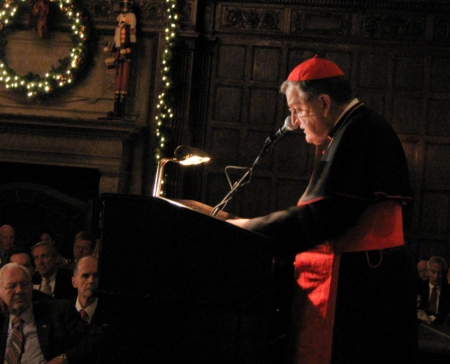 | |
His comment was met with resounding applause from supporters of Thomas More College in Merrimack, N.H. at their annual President's Council Dinner. The event was held at the Harvard Club in Boston on Dec. 4th.
Cardinal Burke has served as prefect of the Vatican's supreme court, the Apostolic Signatura, since 2008 and was archbishop of the Archdiocese of St. Louis before that.
Known for speaking with conviction about moral issues, most often the protection of the dignity of human life, Cardinal Burke has announced publicly that he would deny Communion to Catholic politicians who take positions contrary to Church teaching. He has also stated that Catholics can never vote for a candidate who advocates an absolute right to abortion.
To a culture full of ambiguity and moral relativism, Burke speaks decisively about right and wrong.
He told those gathered at the Thomas More College dinner to be wary of Catholic organizations that brand their names with adjectives and modifying phrases. He lamented the practice of many colleges qualifying their identity, calling themselves things like "Catholic university in the Franciscan or Jesuit tradition." This 'tradition' has little to do with the great tradition of the universal Church, he said.
The name Catholic has its full authentication, he added.
Secularism in the United States has created a "culture of violence and death" that denies the dignity of human life, integrity of marriage and right order of relationships between people. Now more than ever, the Church needs Catholic institutions of higher learning to form their students in the faith properly, he said.
"At the Catholic university, the very manner of study and research should manifest the bankruptcy of the abuse of human life and human sexuality which has come to be standard on many university campuses," he said. "How tragic that the very secularism which a Catholic university should be helping its students to battle and overcome has entered into several Catholic universities, leading to the grievous compromise of their high mission."
One of the first things every Catholic college must address is the "prevalent and utterly destructive error of our time that somehow faith is contradicted by reason," he said.
Students must be equipped to address the truth in their personal lives and society so that they will be able to resist the "secularist dictatorship" that seeks to exclude all religious discourse from the professions and from public life, he said.
In a time marked by religious illiteracy, when many young Catholics are poorly catechized, Catholic schools must teach scripture and tradition. Students must study the fathers of the Church and approved theologians -- above all St. Thomas Aquinas.
"There is really no place for engaging in speculative theology and certainly no time to waste on superficial and tendentious theological writing of the time. What sense does it make, for example, to engage students in the discussion of the possibility of the addition of women to Holy Orders when the students have little or no knowledge of the consistent teaching of the scriptures and tradition on the holy priesthood and on the reservation of priestly ordination to men?" he said.
Cardinal Burke stressed that the primary instructor at every Catholic university must be Jesus Christ. Christ who is alive in his Church must be taught, encountered in the liturgy and followed by leading a life of virtue. Otherwise, the school is not worthy of the name Catholic, he said.
"The presence of Our Lord Jesus Christ on the campus of the college and university is not something additional to or even extraneous to the pursuit of truth. It is rather he alone who can inspire, guide and discipline the professors and students so that they remain faithful in the pursuit and do not fall prey to the temptation which Satan cleverly offers to corrupt us every time we set out to obtain a great good," he said.
Burke said Catholic colleges "nurture the soul of our nation" and praised the great work of Thomas More College in particular. The school imparts a truly Catholic education to which "students and professors grow in their love of Christ."
Dr. William Fahey, president of Thomas More College, spoke with pride about the institution. The college was ranked 7th in the category "most Catholic institutions" out of the nation's 235 Catholic universities by the journal First Things. It is number one in New England.
Fahey added that it is one of 20 Catholic undergraduate institutions in the United States that conform to all requirements of Canon Law, including maintaining a majority of Catholics on the board and requiring faculty to make a profession of faith and fidelity.
By By Christine M. Williams courtesy of The Pilot
Friday, December 10, 2010
Wednesday, December 8, 2010
Feast of the Immaculate Conception
There are very few people I've heard speak more eloquently than this Brother :)
Tuesday, December 7, 2010
China to choose Catholic heads; Vatican ties tense
BEIJING (AP) — China's bishops opened a meeting Tuesday to choose leaders of the government-backed Catholic church amid tensions with the Vatican after it denounced the recent ordination of a bishop who did not have the pope's approval.
The meeting in Beijing to elect new heads of the Chinese Patriotic Catholic Association and the Council of Chinese Bishops will be another source of friction because the Vatican disapproves of such assemblies, saying both organizations run counter to Catholic doctrine.If clerics more interested in shoring up Communist Party control are elected into top positions, it will likely hinder the tentative efforts at outreach made by Pope Benedict XVI.
Chinese authorities also are pressuring some bishops to attend the Beijing meeting, a Vatican-affiliated agency said.
Ties between China and the Vatican already were strained because of a dispute over the Nov. 20 ordination of Rev. Joseph Guo Jincai as bishop. The Vatican also slammed Chinese authorities for forcing Vatican-approved bishops to attend that ordination ceremony.
Communist China forced its Roman Catholics to cut ties with the Vatican in 1951, and worship is allowed only in state-backed churches, although millions of Chinese belong to unofficial congregations loyal to Rome.
The National Congress of Chinese Catholic Representatives runs until Thursday and will be attended by bishops, priests and believers, said Liu Bainian, vice chairman of the Patriotic Association, which supervises the Catholic church, including overseeing the appointment of all of China's bishops.
"It's just an election of a new round of leadership, like the election of the leadership of the National People's Congress," Liu said, referring to the country's rubberstamp legislature. He declined further comment.
The Patriotic Association has for years been a stumbling block to formal ties between the Holy See and Beijing. Run by hard-liners, it does Beijing's bidding, not the Vatican's.
The last chairman of the Patriotic Association, Bishop Fu Tieshan, was a hard-liner who clashed with Rome over Beijing's right to independently appoint bishops without papal approval and the Vatican's diplomatic ties with Taiwan, which China claims as its territory.
Ahead of the conclave, Chinese police sought out at least two bishops in an effort to ensure their attendance, according to AsiaNews, a Vatican-affiliated missionary news agency that closely covers the church in China.
Monsignor Feng Xinmao, bishop of Hengshui, a city in Hebei, was removed from his official residence despite efforts by parishioners and priests to hold back officers, AsiaNews said. He was then taken to an isolated location outside the city southwest of Beijing, it said.
Separately, the bishop of Hebei's Cangzhou city, Monsignor Li Lianggui, had gone into hiding, leading police to say they may issue a nationwide arrest warrant, AsiaNews said.
The meeting has been put off a few times in recent years, perhaps due to the Vatican's objections, said Anthony Lam, a researcher at the church-affiliated Holy Spirit Study Center in Hong Kong. "They know they cannot postpone it forever, so they are trying to do it now as a low-key event," he said.
The two organizations' top positions have been vacant since Bishop Fu's death in 2007. He was head of the Patriotic Association from 1998 and served as acting head of the Bishops' Conference for about two years. Fu's simultaneous control of both bodies underscored the government's tight grip on the official church.
Lam said that despite the recent setback, Beijing still wants to normalize ties with the Vatican.
"For them, a harmonious situation is one of the most important things now in China and so if they can give certain degree of freedom to the church people in return for their loyalty, they would like to do that," Lam said.
Calls to police, government religious affairs bureaus, and Catholic churches in Hengshui and Cangzhou either rang unanswered or were answered by people who said they either had no information or were not authorized to comment. Staff at the Patriotic Association in Beijing said they could not receive telephoned inquiries and Vice Chairman Liu's mobile phone was shut off.
The meeting also comes as about 100 Catholic students at a seminary in Shijiazhuang, capital of Hebei, ended a two-week strike over the appointment of a government official as vice rector of the school, the Bangkok-based Union of Catholic Asian News said. Provincial authorities withdrew the appointment, prompting students to return to classes.
In recent years under Benedict, China-Vatican relations have improved and Benedict has said that restoring diplomatic relations with Beijing is a priority. Disputes over appointments in China's official church have been avoided by quietly conferring on candidates, leading to several ordinations of bishops with the Holy See's blessing.
The ordination of Rev. Guo was the first without papal approval in almost five years, and the Holy See had warned reconciliation efforts would be set back if bishops were forced to attend.
The Vatican blasted the government for allowing the Patriotic Association, and in particular vice chairman Liu, "to adopt attitudes that gravely damage the Catholic Church."
Monday, December 6, 2010
Saint Anthony of Saint Anne Galvão

Last October, a Catholic mother of four was ecstatic when she learned she was pregnant with her fifth child. However, when she went to the doctor to get an ultrasonic first glimpse of the child, she received the dreaded news that there was no baby in her womb. Furthermore, hormonal tests seemed to indicate that she was no longer with child.
Devastated, she returned home. Her pro-life doctor was so certain of a miscarriage, he told her to come back in a week to schedule a D&C.
At home, she called her oldest brother and told him the sad news. Her brother had traveled many times to Brazil and knew the story of the then-Blessed Galvão. He knew that during the saint’s life, he had cured a woman who was dying in child birth by having her swallow a small piece of paper, on which he had written: “Post Partem Virgo, Inviolata Permansisti, Intercede Pro Nobis Sancta Dei Genetrix.” (It is a Latin phrase taken from the hour of Sext in the Little Office of Our Lady, meaning: “After giving birth, O Virgin, Thou remained inviolate, Intercede for us Holy Mother of God.”)
He told his sister the story, explaining that it had become customary for devotees to swallow similar parchments, when asking favors from the saint. In fact, the nuns of Saint Galvão’s convent still make little parchments with the same text printed on them, put them in capsules and distribute them to the faithful. (In fact, during 2006, 90,000 such pills were consumed each month. After the announcement of the saint’s canonization, that number increased to 140,000.)
She was little consoled, but decided to give it a try. Since she did not have time to order the “pills” from Brazil, she simply wrote the phrase on a small piece of paper and swallowed it.
The next week, when she went in for a final check up and to schedule the D&C, her doctor, being pro-life, decided to take another ultrasonic look. Happily he looked up at the mother and asked: “Do you believe in little miracles?”
“I believe in little miracles and big ones too,” she replied.
He said: “Good, because you have a perfectly healthy and full-size baby boy in your womb.”
Overcome with emotion, the mother returned home. A couple of weeks later, she learned that Father Galvão was due to be canonized shortly before her delivery date. Full of gratitude, the family celebrated the saint’s canonization and decided to name the child Anthony, in honor of the saint they believe saved him.
Such stories are common. The nuns at Saint Galvão’s convent keep a tally of the written testimonials of special graces received through the saint’s intercession. The numbers for the years 1930 to 1990 are as follows:
37,673 graces received
7,028 cures
2,702 safe births
332 kidney stones safely passed
123 conversions
Saint Galvão’s prodigious assistance from Heaven is not surprising to those familiar with his life.
The Story of a Saint
 |
| Friar Galvão as priest, painting by unknown author (circa 1850) |
Anthony Galvão was born in 1739 in the village of Guaratinguetá. His father, also named Anthony, belonged to an illustrious Portuguese family and was well educated, as evidenced by his writings. He excelled in business, the military and public administration, leading him to serve well as the village mayor.
His mother, Doña Isabel Leite de Barros, came from Pindamonhangaba in São Paulo State, Brazil. She descended from aristocratic stock on both her paternal and maternal sides. Her great-great grandfather was a famous leader named Fernão Dias Paes Leme, known as the “Emerald Governor.”
Homelife
Anthony was the forth of ten children. Three died in their infancy and the other six married and left many descendents.
However, Anthony always felt inclined to the religious life. At the young age of 13, he left the family home to pursue priestly studies at the Jesuit “Belém Seminary” in Bahia, where he remained for the next five years. While there, he received an excellent formation.
Shortly thereafter, he became a novice in the Franciscan monastery of Saint Bonaventure of Macacu, in the capital of Rio de Janeiro. In religious life, he adopted the name: Friar Anthony of Saint Anne Galvão, as a sign of his devotion to Our Lady and because Saint Anne was his family’s patroness.
Priestly Ordination and Slavery to Mary
He was ordained a priest in 1762, even before he had finished the regular courses of philosophy and theology. This showed the confidence his superiors placed in his virtues and cultural formation.
After ordination, he was sent to São Paulo, where he spent several years finishing his studies and graduated, with highest honors.
As he grew and matured, his devotion to Our Lady increased. In 1766, he consecrated himself as a slave of Mary. Although this devotion was systematized and developed by Saint Louis de Montfort, who had died fifty years earlier, his writings were not yet known.
Nevertheless, the same devotion had been practiced by Sister Agnes of Saint Paul, a Spanish Conceptionist nun, and had gained papal recognition a century before Saint Louis de Montfort.
Almost immediately, many famous historic figures began practicing slavery to Our Lady, such as: Holy Roman Emperor Ferdinand II and his wife, King Philip III and his wife Margarida, Austrian archduke Albert and his wife Elizabeth and, of course, Father Anthony Galvão.
Preacher, Confessor and Apostle
In 1768, he finished his obligatory studies and the provincial chapter of his order named him “preacher, confessor of the people and porter of Saint Francis’ Monastery in São Paulo.”
He extended his apostolate, by walking to all the cities surrounding São Paulo. Throughout the region he was known and admired for his virtues.
In 1770, he was named confessor of the Retreat House of Saint Theresa. While there, he met Sister Helen Mary of the Blessed Sacrament, who had spent many years living in austerity with the community.
During this time, she received visions from Our Lord, Who commanded her to found a new retreat house in São Paulo, where ladies would live as religious, without taking vows. She confided this to Father Anthony and asked his advice.
Balanced and prudent, he was slow to approve of the project. He carefully examined all the circumstances surrounding the supposed apparitions, analyzed Sister Helen’s psychology and recommended that she take much care, so as not to be fooled by the devil.
After much study and thought, he concluded that Sister Helen’s visions were authentic and therefore that the construction of the new house was the will of God. Since he was suspicious of his own judgment, he consulted other clerics who were well known for their wisdom and learning. Unanimously, they agreed with Father Galvão’s decision.
Foundation of the Retreat House Despite Difficulties
However, construction of a new retreat house seemed impossible. The impious Marquis of Pombal was then a highly influential minister of the Portuguese King Joseph I. He influenced the sovereign to prohibit the foundation of any new convents in all Portugal’s lands, which of course included Brazil.
Neither Sister Helen nor Father Anthony recoiled before these seemingly insuperable obstacles, but rather both busied themselves in the project, convinced that if it were truly God’s will, the retreat house would eventually become a reality.
Sister Helen wrote a letter to the Governor of São Paulo, Dom Luiz Antonio de Souza Botelho e Mourão, a noble and pious man. In it, she outlined her plans for the retreat house and asked for his support.
A month later, he responded and pledged all the construction costs. He saw the project as a means of honoring his family’s two special patrons, Our Lord in the Blessed Sacrament and Our Lady of Delight.
Thus, his pledge was made on the conditions that: the retreat house would have perpetual adoration of the Blessed Sacrament, Our Lady of Delight would be made the institution’s patroness and the “nuns” would pray for two intentions: the eternal salvation of he and his family and that he would always remain in the service of God, the King and those for whom he was responsible.
A Shrewd Governor
Attaining Portuguese approval for the project was the next challenge the governor faced. The way he conducted himself, demonstrated the flexibility and shrewdness for which Brazilians are known. He drafted the proposal and sent it to Portugal in a package full of other governmental documents, hoping it would be overlooked.
His hopes were realized when the response came with no mention of the retreat house. Unknowingly, the government in Lisbon had given tacit approval for the project.
Even before governmental permission had been secured, however, the community had been informally established. Sister Helen came to be called Mother Helen Mary of the Holy Ghost and eight young ladies lived a conventual life with her on the site of the future retreat house.
One year later, Mother Helen died in the odor of sanctity. It was a great blow for the aborning community.
The Retreat House Is Closed
Losing their foundress was by no means the least of the “nuns’” problems, but neither was it the worst. In June, Governor Luiz’s administration came to an end and a wicked man named Martim Lopes de Saldanha replaced him. Governor Saldanha despised the new community.
One of his first acts as governor was to persuade the bishop to order its closure. The weak bishop conceded to his wishes and ordered Father Galvão to board up the building. Everything seemed lost.
Father Galvão, always obedient to his superiors, celebrated Mass for the “nuns” on June 29, 1775 and after giving them Holy Communion, told them the sad news with calm and resignation. His attitude, in face of the apparent ruin of his life’s work, justifies the epitaph that describes him on his tombstone, which reads: “He always held his soul in his hands.”
Heroic Resistance
Nevertheless, true obedience does not mean one must be a drone. Perhaps it was the formation Father Galvão had given the “nuns” that taught them this lesson. They analyzed the Bishop’s order and, seeing that it only commanded them to close the house, but not disband, all but three secretly continued to live as religious behind the boarded windows and doors.
Doing so required heroic confidence. They had no food or water on the premises and could not ask help from anyone outside their walls lest their presence be betrayed, which would almost certainly provoke the bishop to disband them.
They lived in this desperate situation for over a month. During this time, Providence provided for them in a spectacular manner that is described in the convent’s chronicles:
The amount of work was tremendous. They endured hunger and miseries, maintaining the absolute resolve to remain…They ate without flour or salt, abandoning themselves entirely to Providence. After some time, even their benefactors from the city gave up hope that they were there, since all the doors were shut and the convent showed no signs of life.
However, God, Whose Providence especially protects those who serve Him with constancy, manifested His love, sustaining them with His grace and working miracles, two of which are described below.
The first was when the “nuns,” having spent several days without water, resolved to implore God’s mercy. They met in the choir and began to pray, fervently. Immediately, the sky clouded over and began to thunder. A torrential rain began and continued until all the vessels they had in the house were filled. Shortly afterwards, the rain stopped.
The other miracle involved a strawberry patch that was within the walls. The “nuns” ate all the tender leaves and shoots that grew, since they had no other food. Nevertheless, the patch grew so much and produced such an amount of fruit that the “nuns” were not able to eat it all…many strawberries were left out to rot.
Our Lord did not leave them in this state of desperation for long. In less than two months, the bishop lifted the ban on the retreat house and the community again began to prosper.
Providential Help: The Viceroy’s Support
The retreat house, which became know as the “Convent of Light,” was not destined to suffer persecution for the whole of Father Galvão’s life. The Portuguese viceroy, who had jurisdiction over São Paulo’s governor, was favorable to the convent. When he heard of its closing by Gov. Martim, he immediately sent a letter, reprimanding the politician.
While this eased the pressure against the retreat house, it hardly assuaged the persecution the governor waged against Father Galvão. Shortly thereafter, the minister unjustly condemned a soldier to death. Saint Anthony pointed out the injustice and united his voice to many others in protest. The proud governor condemned Father Galvão to exile and ordered him to leave immediately for Rio de Janeiro.
As always, Father Anthony held his soul in his hands and immediately prepared for departure, without a word of complaint. However, before he left the city, the citizens of São Paulo rose up to defend him.
They threateningly circled the governmental palace and obliged Gov. Martim to rescind Father Anthony’s sentence. When he did so, the saint calmly unpacked and continued his ministry in São Paulo. In 1782, Governor Martim left office and the public authorities never again persecuted the Convent of Light.
Saint Anthony, the Miracle Worker
No report on Saint Galvão’s life would be complete without narrating some of the many miracles he performed. These marvels were often subtle. For example: on a trip he made through the Brazilian countryside, he arranged to stay the night with a couple he had befriended.
This couple was having marital problems and argued incessantly. When time for bed arrived, the couple directed the saint to his room, but when he approached it he stopped and refused to enter. Pointing to the master bedroom, he said: “I must sleep in that room.”
Taken aback, the couple agreed, all went to sleep and the next morning, Saint Galvão moved on to another city. Much to the couple’s delight, from that day on they never argued again.
Other wonders were less subtle. As is often the case with founders, he was gifted with discernment of the thoughts and souls of others. Once, going to procure donations for the convent, he traveled to the house of a well-known rich man in another city. A drifter, who knew of the saint, but was not yet convinced of his virtue, saw him approach the house and thought silently to himself: “Father Galvão just arrived and already he is going to adulate the rich.”
Immediately, Saint Anthony turned around and said: “My brother, do not rash judge me. I am not going to adulate the rich, but merely ask this man for a donation for my convent.”
The astonished transient left, no longer doubting the priest’s sanctity.
In addition, Saint Anthony was known to levitate during prayer and bi-locate to bring the sacraments to the dying.
Architect, Engineer, Superintendent and Manual Worker
After the persecutions of the Convent of Light ceased, Saint Anthony dedicated himself to finishing construction on the convent and its chapel and spiritually forming the community.
He wrote the “nuns” a rule of life that they continued to use until 1929, when they received official Vatican approval and joined the Conceptionist order.
The construction work was another matter. All in all, Saint Anthony dedicated 48 years to building the chapel and convent. During that time, he served as architect, engineer, superintendent and manual laborer.
Saint Anthony died in 1822, before the completion of the church’s tower. While suffering in his final illness, he designed the tower and wrote its architectural plans on the wall of his sickroom.
He was buried in the beautiful chapel of the Convent of Light that he had spent his life constructing. During life, he maintained strict poverty for himself and his “nuns.” However, he spared no expense in building the House of God. He constructed the Church of the finest materials and richly decorated it.
The magnificent complex still stands today, where pilgrims visit the shrine and beg favors while venerating the saint’s remains.
This article is a summary of an article published in the monthly Brazilian magazine Catolicismo by Armando Alexandre dos Santos. It was translated, edited and summarized by Michael Whitcraft, who also added several sections and facts. All this was done without the author’s revision. All facts herein contained come from this Catolicismo article and the book, Frei Galvão, Bandeirante de Cristo (Portuguese), written in 1954 by Maristela.
Some Facts about the "Pills" and the Novena
These tiny pills, made out of rice paper, bear words that read, in Latin, “Post partum Virgo, inviolata permansisti, Dei Genitrix, intercede pro nobis” (After birth, the Virgin remained intact, Mother of God, intercede on our behalf) and are associated with numerous miraculous healings as well as the intercession of Friar Galvao. They are the prime devotional example of Friar Galvao's significant reputation as a healing saint, and for that reason they deserve some study and background.
[The pills are] assembled in five locations around Sao Paulo state, including by women in Galvao's hometown of Guaratingueta, who gather every afternoon in a room above the local cathedral. The pills also are made by cloistered nuns at the Convent of Light in Sao Paulo, where Galvao died in 1832 at age 83.
Believers swallow three seed-sized pills over nine days, during which they recite the prayer printed on the paper.
The monk started the tradition of the pills in the late 18th century when he wrote his famous prayer on three pieces of paper in Sao Paulo and asked a woman who was having a difficult pregnancy to eat them. She reportedly went on to give birth to a healthy child. Demand for the pills surged.Things get even more interesting because both of the two documented cases of miraculous healings that were used in Galvao's canonization process involved the consumption of the his pills.
NOVENA TO FRIAR GALVÃO
Prayer to the Holy Trinity:
Most Holy Trinity, Father, Son and Holy Ghost, I adore, praise and thank Thee for the benefits which Thou hast done for me. I beseech Thee, for all that thy Servant Friar Antonio de Santanna Galvão suffered and accomplished, that Thou increase my faith, hope and charity and deign grant me the grace that I ardently desire. Amen.
Our Father, Hail Mary and Glory Be.
Say the Prayer to the Holy Trinity for nine days. Take three pills during the novena: one on the first day, another on the fifth day, and another on the last day of the novena.
 Saint Friar Galvão | |
| Born | 1739 Guaratinguetá, Brazil |
|---|---|
| Died | December 23, 1822 São Paulo, Brazil |
| Venerated in | Roman Catholic Church |
| Beatified | 8 April 1997, Rome by Pope John Paul II |
| Canonized | 11 May 2007, São Paulo by Pope Benedict XVI |
| Major shrine | Monastery of Light, São Paulo |
| Feast | 11 May |
Sunday, December 5, 2010
I Disagree With Fr. Corapi! Or A Cry For Help?
Posted: 04 Dec 2010 09:26 PM PST
Sometimes the comments in Courageous Priest gets are gut wrenching. When someone honestly shares their heart breaking story, it can be very emotional and yet a grace filled moment. Let me introduce you to Bobby. After you read this, can you please do me a little favor by helping out Bobby with my request at the end of the post?
Bobby left them a comment. One full of sorrow. He questions the comments in Father Corapi’s Christmas message to us. To refresh you here is the post. Bobby’s comment centered around this Fr. Corapi message:
This year approach Christmas as you would approach the Christ Child himself � with reverence and with thanksggiving. Allow nothing to rob your joy at this precious time. Sadness has no place in reality, true reality, for the Word has become flesh and dwelt among us. Humanity and divinity have been joined in Jesus, now come to us as an infant. In the cold winter of human hearts there is often no room at the Inn for the Holy Family. Make room in the warmth of your heart for the infant King the Lord of Lords and King of Kings.
Bobby’s comment:
In most cases, I will agree with Father Corapi. But I keep going back to “Reality demands that at Christmas we will to be happy, after all “A Child has been born to us!”” Christ was born, and a Child has been born to us. Over two months ago my wife and I’s firstborn died during childbirth very suddenly and unexpectantly. In our case, a child was born to us, but it was not to last.We are joyful for Christ and His gift of salvation, but heartbreak and sadness is still prevalent. I don’t think my wife chooses to be sad, and despite her best efforts and staying close to the sacraments, she doesn’t cry at night because she is happy, but rather it’s because she is sad, and completely heartbroken. I am doing a little better than her, but I am not exactly happy either, and there isn’t a day or moment that goes by that I don’t think about how Mary Catherine will not be with us this Christmas.Some people should be happier during this time, but in reality, suffering still occurs, and happiness sometimes is not possible. To say that sadness has no place in Christmas or any other time is taking a wide brush to paint something that isn’t reality.
Here is my simple request:
Can you PLEASE leave Bobby an encouraging comment?
- Maybe the voice of hope?
- How about a comment of something related that has happened to you and the results God has given you?
- Can you share in more detail what Fr. Corapi is teaching us?
But most of all . . .
Can you share what prayers and sacrifices you are willing to make for Bobby and his family? Could you? Even if you don’t normally leave comments, can this be the exception? Courageous Priest is asking for well over 50 comments.
Will you do your part?
Can you post this on Facebook or your website?
PLEASE POST COMMENTS ON THE CORAGEOUS PRIEST WEBSITE TO BE SURE BOBBY WILL SEE THEM!
Thank you ... and may our most loving Father bless you abundantly for your kind charity to this couple!
Subscribe to:
Posts (Atom)