

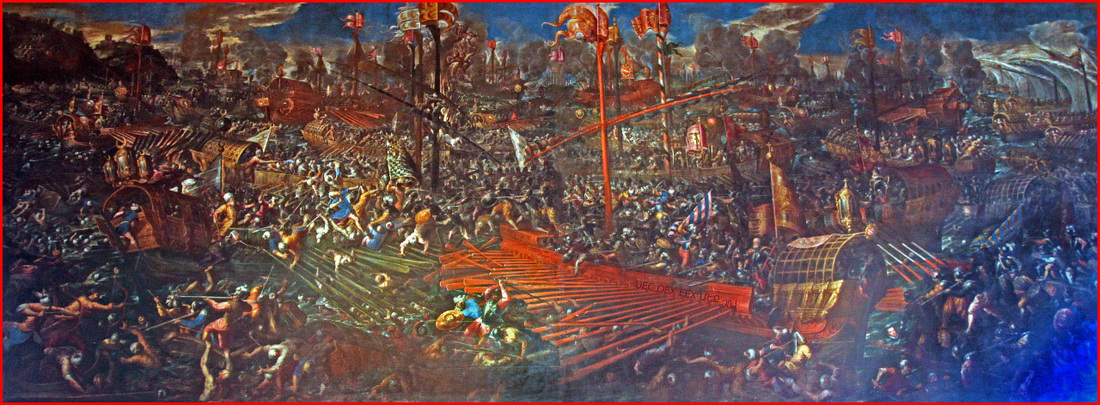
On October 7, the Roman Catholic Church celebrates the yearly feast of Our Lady of the Rosary. Known for several centuries by the alternate title of “Our Lady of Victory,” the feast day takes place in honor of a 16th century naval victory which secured Europe against Turkish invasion. Pope St. Pius V attributed the victory to the intercession of the Blessed Virgin Mary, who was invoked on the day of the battle through a campaign to pray the Rosary throughout Europe.
The feast always occurs one week after the similar Byzantine celebration of the Protection of the Mother of God, which most Eastern Orthodox Christians and Eastern Catholics celebrate on October 1 in memory of a 10th-century military victory which protected Constantinople against invasion after a reported Marian apparition.
Pope Leo XIII was particularly devoted to Our Lady of the Rosary, producing 11 encyclicals on the subject of this feast and its importance in the course of his long pontificate.
.jpg) In the first of them, 1883's “Supremi Apostolatus Officio,” he echoed
the words of the oldest known Marian prayer (known in the Latin
tradition as the “Sub Tuum Praesidium”), when he wrote, “It has always
been the habit of Catholics in danger and in troublous times to fly for
refuge to Mary.”
In the first of them, 1883's “Supremi Apostolatus Officio,” he echoed
the words of the oldest known Marian prayer (known in the Latin
tradition as the “Sub Tuum Praesidium”), when he wrote, “It has always
been the habit of Catholics in danger and in troublous times to fly for
refuge to Mary.”“This devotion, so great and so confident, to the august Queen of Heaven,” Pope Leo continued, “has never shone forth with such brilliancy as when the militant Church of God has seemed to be endangered by the violence of heresy … or by an intolerable moral corruption, or by the attacks of powerful enemies.” Foremost among such “attacks” was the battle of Lepanto, a perilous and decisive moment in European and world history.
Troops of the Turkish Ottoman Empire had invaded and occupied the Byzantine empire by 1453, bringing a large portion of the increasingly divided Christian world under a version of Islamic law. For the next hundred years, the Turks expanded their empire westward on land, and asserted their naval power in the Mediterranean. In 1565 they attacked Malta, envisioning an eventual invasion of Rome. Though repelled at Malta, the Turks captured Cyprus in the fall of 1570. The next year, three Catholic powers on the continent – Genoa, Spain, and the Papal States - formed an alliance called the Holy League, to defend their Christian civilization against Turkish invasion. Its fleets sailed to confront the Turks near the west coast of Greece on October 7, 1571.
Crew members on more than 200 ships prayed the Rosary in preparation for the battle - as did Christians throughout Europe, encouraged by the Pope to gather in their churches to invoke the Virgin Mary against the daunting Turkish forces.
Some accounts say that Pope Pius V was granted a miraculous vision of the Holy League's stunning victory. Without a doubt, the Pope understood the significance of the day's events, when he was eventually informed that all but 13 of the nearly 300 Turkish ships had been captured or sunk. He was moved to institute the feast now celebrated universally as Our Lady of the Rosary.


 The
idea that each soul has assigned to it a personal guardian angel has
been long accepted by the Church and is a truth of our faith. From the
Gospel of today's liturgy we read: "See that you do not despise one of
these little ones, for I say to you that their angels in heaven always
look upon the face of my heavenly Father" (Matthew 18:10).
The
idea that each soul has assigned to it a personal guardian angel has
been long accepted by the Church and is a truth of our faith. From the
Gospel of today's liturgy we read: "See that you do not despise one of
these little ones, for I say to you that their angels in heaven always
look upon the face of my heavenly Father" (Matthew 18:10).