There is much conflict and turmoil in the Middle East as we well know. Many Christians, particularly Catholics are being persecuted unto death. Iran feels it's their job to bring about Armageddon in order to hasten the return of their Mahdi who will make all people Muslim and wants to wipe Israel off the face of the earth "that her name be no more remembered". Israel is taking them very seriously, as well they should, and many feel an attack against Iran's nuclear facilities is immanent.
Many modern day prophets and prayerful faithful will spend tomorrow immersed in the powerful prayer of the Most Holy Rosary .. all 20 mysteries, either at once or throughout the day as time permits according to your station in life. Please join the many who will offer this time of fervent prayer for peace in the Middle East, as well as all countries, communities, families and our own hearts.
We pray courage, peace, protection and mercy for all .. and as always; God's Perfect Divine Will be done on earth as It is in heaven!
May all come to know the Fullness of TRUTH that is our Lord and Savior, Jesus Christ .. His mercy is as endless as His compassion is inexhaustible.

Tuesday, February 28, 2012


Monday, February 27, 2012
Romney Told Catholic Hospitals to Administer Abortion Pills

Romney announced this decision -- saying it was the "right thing for hospitals" to do -- just two days after he had taken the opposite position.
The story begins in 1975, when Massachusetts enacted a law that said, "No privately controlled hospital .. shall be required to permit any patient to have an abortion ... or to furnish contraceptive devices or information to such patient ... when said services or referrals are contrary to the religious or moral principles of said hospital ... ."
Twenty-seven years later, when Romney was running for governor, he filled out a questionnaire for NARAL Pro-Choice Massachusetts. It said: "Emergency contraception does not cause abortion. Rather, it prevents pregnancy from occurring. Will you support efforts to increase access to emergency contraception?"
Romney said: "Yes."
The next year, the Massachusetts legislature considered an "emergency contraception" mandate. It would have allowed pharmacists to sell Plan B -- an abortifacient -- without a prescription and without parental consent. It also would have required all hospitals to inform rape victims of the availability of such "emergency contraceptives" and provide them to the rape victim if she wanted them even when they would cause an abortion.
Maria Parker of the Massachusetts Catholic Conference, the public policy organization of the state's Catholic bishops, explained in testimony to the state legislature why Catholic hospitals could not do this.
The normal Catholic ban on artificial contraception did not apply in a rape case, Parker said. But while contraception was acceptable in such a situation, killing an unborn child was not.
In keeping with this moral understanding, one Massachusetts Catholic hospital chain would later explain to the Boston Globe that its practice was to test a rape victim to make certain she was not pregnant and only then give her emergency contraceptives. If the test proved the woman was pregnant, the hospital would not give the woman the drugs because they could not prevent conception but they could kill her child.
Parker concluded her testimony by quoting what Cardinal Frances George of Chicago had told the Illinois legislature when it proposed a similar law: "Our hospitals cannot and will not comply with this law."
In that session, the Massachusetts Senate passed the "emergency contraception" bill, but it was blocked in the House.
As Planned Parenthood and NARAL demanded action on the bill, and the Massachusetts Catholic Conference continued to speak out against it, Gov. Mitt Romney remained mum.
"Shawn Feddeman, spokeswoman for Gov. Mitt Romney, declined to comment on the governor's position on the bill," the Boston Globe reported on July 1, 2004. "'We'll review it when it reaches the governor's desk.'"
The bill was reintroduced in the next session -- and Romney remained mum.
Romney had "no opinion on the bill," his spokesman, Eric Fehrnstorm, told The Associated Press in April 2005. "We'll take a look at the bill should it reach the governor's desk."
But the bill had veto-proof support in both chambers of the Democrat-controlled legislature in 2005. In July, the House and Senate reached a compromise on it that would protect Catholic hospitals from being forced to act against their faith.
At that time, the Massachusetts Catholic Conference published a bulletin explaining what happened. The House had included language to "expressly apply" the 1975 conscience law protections to the new emergency contraception law. The Senate had included language saying the new law should apply "notwithstanding" any existing law.
"In the end, neither amendment was included in the bill," said the Massachusetts Catholic Conference. "House Majority Leader John Rogers, who worked tirelessly behind the scenes to defend the hospitals' right of conscience, made it clear during floor debate on July 21 that the House blocked the Senate amendment so that the 1975 conscience statute would continue to have full effect."
The conference provided me with a copy of this bulletin, and Rogers assured me its account was "accurate and true."
The Catholic Church still opposed the bill because it would facilitate abortions. But at least the religious liberty of Catholic hospitals had been preserved -- or so it seemed.
On July 25, 2005, Romney vetoed the bill -- even though it was clear his veto would be overridden.
He published an op-ed in the Boston Globe the next day explaining his decision. "The bill does not involve only the prevention of conception," he wrote. "The drug it authorizes would also terminate life after conception." Romney said the veto kept his pledge not to change the state's abortion laws.
Romney made no mention of the religious liberty issue in his op-ed. But then, the bill, as the Massachusetts Catholic Conference and the House majority leader understood it, did not allow coercion of Catholic hospitals.
On Dec. 7, 2005, a week before the law was to take effect, the Boston Globe ran a piece headlined: "Private Hospitals Exempt on Pill Law." The article said the state Department of Public Health had determined that the emergency contraception law "does not nullify a statute passed years ago that says privately run hospitals cannot be forced to provide abortions or contraception."
Public Health Commissioner Paul Cote Jr. told the Globe: "We felt very clearly that the two laws don't cancel each other out and basically work in harmony with each other."
Romney spokesman Fehrnstrom told the Globe that Romney agreed with the Department of Public Health on the issue. The governor, he said, "respects the views of health care facilities that are guided by moral principles on this issue."
"The staff of DPH did their own objective and unbiased legal analysis," Romney's spokesman told the Globe. "The brought it to us, and we concur in it."
The Globe itself ruefully bowed to this legal analysis. It ran an editorial headlined: "A Plan B Mistake." "The legislators failed, however," the Globe said, "to include wording in the bill explicitly repealing a clause in an older statute that gives hospitals the right, for reasons of conscience, not to offer birth control services."
Liberals joined in attacking Romney's defense of Catholic hospitals. But that defense did not last long.
The same day the Globe ran its editorial, Romney held a press conference. Now he said his legal counsel had advised him the new emergency contraception law did trump the 1975 conscience law.
"On that basis, I have instructed the Department of Public Health to follow the conclusion of my own legal counsel and to adopt that sounder view," Romney said. "In my personal view, it's the right thing for hospitals to provide information and access to emergency contraception to anyone who is a victim of rape."
A true leader would have said: I will defend the First Amendment right of Catholics to freely exercise their religion -- against those who would force them to participate in abortions -- all the way to the Supreme Court.
Sunday, February 26, 2012
The Heart of the Matter? ---- Disipline!
Father Barron explains the term "Taking the Disipline" and why Pope JP II practiced it with much love and devotion.
Thursday, February 23, 2012
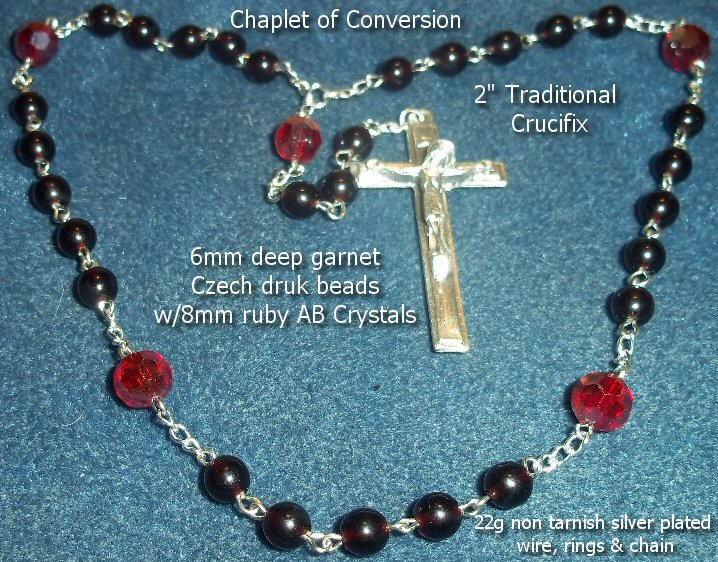
Two New Chaplets
These two wonderful chaplets were recently brought to my attention by a prayerful customer and I wanted to share them with everyone being it's the Lenten season. They are the Chaplet of Reparation and Conversion, respectively. Both wonderful devotions for Lent. We need so much to make reparation for all going on in the world today ... for all those that do not adore, do not believe, hope or love! And we also need to pray for our loved ones and those we hold dear who may be too into the world to realize that God's really there and waiting for them to return His Love.
Both of these chaplets will be made to order. Your choice of color and beads; wire or corded. The basic price is $18 for acrylics or glass in 6mm. Till the end of Lent, I'll extend that to include even 8mm beads for the same price. There are instructions on how to pray each chaplet on the site ... just click the names. They're very easy chaplets to learn.
Want them for $15 during Lent only? Then send me an email with $15 chaplet in the subject line and they're yours. Please note, if you use the buttons on the site, you'll be charged the full $18 .. nothing I can do about that. (Offer good only in 2010)


Both of these chaplets will be made to order. Your choice of color and beads; wire or corded. The basic price is $18 for acrylics or glass in 6mm. Till the end of Lent, I'll extend that to include even 8mm beads for the same price. There are instructions on how to pray each chaplet on the site ... just click the names. They're very easy chaplets to learn.
Want them for $15 during Lent only? Then send me an email with $15 chaplet in the subject line and they're yours. Please note, if you use the buttons on the site, you'll be charged the full $18 .. nothing I can do about that. (Offer good only in 2010)

St. Peter Damian
 |
| Feastday: February 23 |
Wednesday, February 22, 2012
Hollywood Actress leaves Glitter for God
 |
Click for short video http://youtu.be/6H39k9jfKMw
Mother Dolores, as she is now known, is the subject this year of an Oscar-nominated documentary short, "God Is the Bigger Elvis," which airs April 5 on HBO. The documentary chronicles her life as a nun after a Hollywood career that saw her costar with Elvis Presley ("Loving You" in 1957 and "King Creole" in 1958), Anthony Quinn ("Wild Is the Wind," 1957) and George Hamilton ("Where the Boys Are," 1960). Her favorite is "Lisa," from 1962, in which she played a Jewish refugee after World War II. Before the documentary, she last appeared on the big screen in 1963's "Come Fly With Me," a comedy about flight attendants looking for love.
Not only does "God Is the Bigger Elvis" explore Mother Dolores' life in Hollywood and at the monastery, but it also chronicles the day-to-day life of the nuns at the abbey, which is also a working farm. Like Mother Dolores, a lot of the nuns had previous occupations, including the law and science, before they changed vocations.
The documentary's director, Rebecca Cammisa, whose own mother was a nun before leaving the convent after 10 years, is thrilled that Mother Dolores is going with her to the Academy Awards on Sunday. "This is her return to Hollywood after 50 years," said Cammisa. "This is her homecoming."
While an actress, Mother Dolores attended the Academy Awards three times, the last being April 9, 1962, at the Santa Monica Civic. As for her return after half a century, Mother Dolores said over the phone from the abbey that she was looking forward to seeing "the motion picture industry at work."
"I would like to see the academy at its best," she added. "I have such respect for the community, and they have given me a way of being a part of Hollywood within the monastic enclosure. So this will be a wonderful opportunity I certainly will never enjoy again in my lifetime."
Mother Dolores had been a devout Catholic before she joined the monastery — she converted to the faith when she was 10. While appearing on Broadway in 1959 in the comedy "The Pleasure of His Company," a friend told her to visit the tranquil monastery for some rest and contemplation. It was during this first visit that Mother Dolores felt a tug at her heart that maybe she should devote her life to God. But she was only 21 and the community's lady abbess felt she was too young to give up her career in Hollywood.
But four years later, Mother Dolores knew the time was right. "I think it was maturity," she said. "There was a realization I had gone through many more films and I had much more experience in Hollywood and more experience in life. I had come to understand more the implications of what was necessary. I think that eventually the realization of what needed to happen caught up with me. I was able to present to lady abbess a more mature character.
Leaving the film industry for her new vocation "was something I knew absolutely I must do even though I loved my career," she said.
"I really did. I had wanted it since I was 7 years, so I certainly wasn't leaving it because I didn't like or love it. It was just something I knew that God was asking."
She dropped her academy membership at the advice of the lady abbess, but it was reinstated in 1990 after the personal intervention of actor Karl Malden, the then-president of the Film Academy (and who had worked with her on "Come Fly With Me").
"They could send me films to be evaluated, which they couldn't do in the 1960s," she said. "He felt my opinion would be important to them. He felt to have an opinion of someone who had led a contemplative life would have significance. The lady abbess was completely convinced by him. I was reinstated. I had to pay my dues; we didn't want to take any privileges that weren't appropriate."
Mother Dolores said she isn't shocked by anything she sees in contemporary films. "We are a contemplative community but also a community that is based on hospitality," she said. "We receive visitors and meet visitors who need help. There isn't really too much in movies that we haven't seen on our doorstep. Hollywood reflects the problems in the society. I don't think Hollywood creates the problems."
And if the documentary wins, will she accompany director Cammisa onstage?
"I will do whatever they ask me to," Mother Dolores said with a soft laugh.
Saturday, February 18, 2012
ORDINARY PUBLIC CONSISTORY - February 2012
 | |||
Pope Benedict appointed 22 new cardinals at the Vatican on Saturday, with his choices for the lofty role likely to influence who will be appointed as the next pontiff.
Among those to be elevated to the College of Cardinals are New York Archbishop Timothy Dolan, cementing his standing as the top Catholic in the United States, and Archbishop Edwin F. O'Brien of Baltimore.
Others include Archbishop Thomas Collins, from Toronto, as well as the Bishop of Hong Kong, John Tong Hon, and Major Archbishop George Alencherry from India
Senior clerics from Germany, the Netherlands, the Czech Republic, Romania and Brazil are also represented, as well as several from Italy.
The College of Cardinals was established in 1150. Its main role is to advise the current Pope and pick his successor.
"This is the most exclusive club in the Catholic Church," said John Allen, CNN's Vatican analyst. "In many cases, you also become, at least informally, a candidate to be the next pope, because the next pope will almost certainly come from the roughly 120 cardinals under the age of 80."
Once a cardinal reaches 80, he is no longer able to participate in the election of the pope or enter the secret conclave where cardinals gather when the time comes to select the next pope, typically upon the prior pope's death.
The new cardinals each professed their faith and swore an oath of obedience to Pope Benedict and his successors during Saturday's ceremony, called the Consistory, at the Vatican.
They then walked one by one to the pontiff and knelt in front of him to receive the traditional red hat, or "biretta," and gold ring, and a document with the name of the cardinal's titular church in Rome.
In his address, Benedict said that in joining the College of Cardinals, the clerics would "be united with new and stronger bonds not only to the Roman Pontiff but also to the entire community of the faithful spread throughout the world."
Emphasizing the importance of service over self-interest, the pontiff said the red of the cardinals' hats was symbolic of the ultimate sacrifice they would make if required.
"The new cardinals are entrusted with the service of love: love for God, love for his Church, an absolute and unconditional love for his brothers and sisters, even unto shedding their blood, if necessary, as expressed in the words of placing the biretta and as indicated by the color of their robes," he said.
Pope Benedict also announced seven new saints, including the first Native American saint, a 17th-Century Mohawk woman called Kateri, or Catherine, Tekakwitha, who was a Catholic convert.
Existing members of the College of Cardinals and the new cardinals-elect came together for a day of prayer and reflection Friday, in preparation for the ceremony, according to the Holy See Press Office.
Dolan addressed the gathering on the subject of evangelization, saying there was a need to challenge a growing secularization of society.
For homily and video, please click this Vatican link.
Friday, February 17, 2012
Catholics must know truth if they are to share it, pope tells cardinals
 |
Pope Benedict XVI prays at the start of a meeting of the world's cardinals in the synod hall at the Vatican Feb. 17. At right is Cardinal Angelo Sodano, dean of the College of Cardinals. |
If objective truth does not exist, "there is no compass and we won't know where to go," Pope Benedict XVI told members and almost-members of the College of Cardinals.
An awareness of the truth of the revelation of God in Jesus Christ makes life "rich and beautiful" and is essential for sharing the Christian faith with others, the pope said Feb. 17 at the end of a daylong meeting of the College of Cardinals.
The pope thanked Cardinal-designate Timothy M. Dolan of New York, who gave the day's main presentation on missionary activity and the new evangelization. The pope said the New York prelate's talk was "enthusiastic, joyful and profound."
In his morning address to the group, which included most of the 21 other churchmen who were to be made cardinals with him Feb. 18, Cardinal-designate Dolan said secularism has had an easy time spreading through many traditionally Christian cultures because so many Christians do not know their faith and do not grasp the truth it teaches.
While the New York prelate did not downplay the challenges the church faces in reviving the faith of its members and bringing the Gospel to those who have never heard it, he delivered his assessment with his characteristic smile and broad gestures, telling Pope Benedict and the cardinals that evangelization requires joy and love.
"When I became the archbishop of New York, a priest told me, 'You better stop smiling when you walk the streets of Manhattan or you'll be arrested,'" he said, but he still believes Christians must show the world that faith is saying yes "to everything decent, good, true, beautiful and noble."
The meeting was attended by 133 prelates, including at least 20 of the 22 who were to receive their red hats from the pope the following morning.
During the morning session, Pope Benedict did not address the assembly and was not one of the seven participants who commented on the presentation by Cardinal-designate Dolan, although the pope did laugh when the New York archbishop made fun of his speaking Italian "like a child."
The morning session also featured a brief presentation by Archbishop Rino Fisichella, president of the Pontifical Council for the New Evangelization, on plans for the 2012-2013 Year of Faith.
The pope spoke at the end of the evening session, after another 20 cardinals and cardinals-designate had taken the floor to speak.
Pope Benedict told the assembly that the teachings of the Second Vatican Council were important for "rediscovering the relevance of Jesus and of faith" today, and he echoed Cardinal-designate Dolan's call for a true renewal of catechesis to combat what has been defined as "religious illiteracy."
In his morning presentation, Cardinal-designate Dolan said that when Cardinal Angelo Sodano, dean of the College of Cardinals, asked him to be the main presenter, he hinted that he did so because New York "might be the 'capital of secular culture.'"
"New York -- without denying its dramatic evidence of graphic secularism -- is also a very religious city," he said, where even those "who boast of their secularism" exhibit an openness to the divine and have questions about God.
While secularism "is invading every aspect of daily life," the New York prelate said, it also is true that most people, on some level, still question the ultimate meaning of life and still ponder the idea of God.
"Even a person who brags about being secular and is dismissive of religion has within an undeniable spark of interest in the beyond, and recognizes that humanity and creation is a dismal riddle without the concept of some kind of creator," he said.
The cardinal-designate said those people don't want to be considered objects of missionary activity, but Christians have an obligation to help them maintain their search for meaning in life.
Humility, joy and love are key to the success of the evangelization efforts of the church and its members, he said.
"Triumphalism in the church was dead" after the Second Vatican Council, he said, but "so was confidence."
Catholics recognize that they and their church need conversion, too, he said. And, they must be convinced that what they are sharing with others is not a doctrine, but the person of Jesus.
At the same time, because Jesus is the truth, Catholics must make a commitment "to combat catechetical illiteracy," he said.
"True enough, the new evangelization is urgent because secularism has often choked the seed of faith, but that choking was sadly made easy because so many believers really had no adequate knowledge or grasp of the wisdom, beauty and coherence of the truth," he said.
Cardinal-designate Dolan said that on the eve of receiving his red hat from the pope, he also had to speak of the fact that Christians are called to love and serve the church and their neighbors, even to the point of shedding their blood if necessary.
The cardinals, he said, "are but 'scarlet audiovisual aids' for all our brothers and sisters," who also are called "to be ready to suffer and die for Jesus."
Jesuit Father Federico Lombardi, Vatican spokesman, did not release the names of the 27 cardinals who intervened in the discussion, but he summarized the points that were made. Several of the cardinals, he said, spoke about the difficulties evangelizing in their specific countries or cultures.
Mention was made of the growing number of Christians in China, "despite the difficulties," presumably with government control over religion; about interreligious dialogue and the fight against poverty in India; the important role of popular religious devotions for evangelization in Latin America; and about secularism's attempts to marginalize religion in the West.
Participants insisted on the importance of ecumenism for fostering a common Christian witness to the faith, on the continuing relevance of the Second Vatican Council as a guide for the church today and on the value of Christian joy and holiness for evangelization, he said.
By Cindy Wooden
Catholic News Service
Sunday, February 12, 2012
We Cannot—We Will Not—Comply With This Unjust Law
The Administration Is Denying Catholics The
Fundamental Freedom of Religious Liberty
Dear friends in the Lord,
I write to you concerning an alarming and serious matter that negatively impacts the Church in the United States directly, and that strikes at the fundamental right to religious liberty for all citizens of any faith. The federal government, which claims to be “of, by, and for the people,” has just dealt a heavy blow to almost a quarter of those people—the Catholic population—and to the millions more who are served by the Catholic faithful.
 |
| Fictitious Picture Used To Illustrate A Point |
We cannot—we will not—comply with this unjust law.
People of faith cannot be made second class citizens. We are already joined by our brothers and sisters of all faiths and many others of good will in this important effort to regain our religious freedom. Our parents and grandparents did not come to these shores to help build America’s cities and towns, its infrastructure and institutions, its enterprise and culture, only to have their posterity stripped of their God given rights. In generations past, the Church has always been able to count on the faithful to stand up and protect her sacred rights and duties. I hope and trust she can count on this generation of Catholics to do the same. Our children and grandchildren deserve nothing less.And therefore, I would ask you two things. First, as a community of faith we must commit ourselves to prayer and fasting that wisdom and justice may prevail, and religious liberty may be restored. Without God, we can do nothing; with God, nothing is impossible. Second, I would also recommend visiting www.usccb.org/conscience, to learn more about this severe assault on religious liberty, and how to contact Congress in support of legislation that would reverse the Administration’s decision.
With prayerful best wishes, I am,
Faithfully in Christ,
Cardinal-designate Timothy M. Dolan
Archbishop of New York
Subscribe to:
Posts (Atom)